





 English
 USA
 西班牙语
 俄罗斯
 葡萄牙
 印尼
 巴基斯坦
 尼日利亚
 孟加拉
 墨西哥
 越南
 日本
 韩国
 沙特阿拉伯

As consumers become increasingly interested in natural, minimalist, and environmentally conscious personal care products, water-based wet wipes are attracting growing attention. Many parents, skincare consumers, and brands looking to simplify their product formulations are asking the same question: Can natural wet wipes be made with water only?
At first glance, the answer seems straightforward. If water is the primary ingredient in wet wipes, why add preservatives, surfactants, fragrances, or other functional ingredients? Wouldn't a water-only formulation be a simpler and more natural choice?
For wet wipes manufacturers, however, the answer involves more than the ingredient list. A commercially viable wet wipe must meet requirements for microbiological quality, shelf life, packaging compatibility, fabric performance, and intended use. Removing ingredients may simplify the formulation, but it can also create new technical challenges.
In this article, we explore whether water-only wet wipes are practical, what manufacturers should consider when developing them, and when a minimalist water-based formulation may be a better option than using water alone.
Whether you manufacture baby wipes, facial wipes, personal cleansing wipes, or other types of wet wipes, understanding these factors can help you make better formulation decisions.
1. What Are Water-Only Wet Wipes?
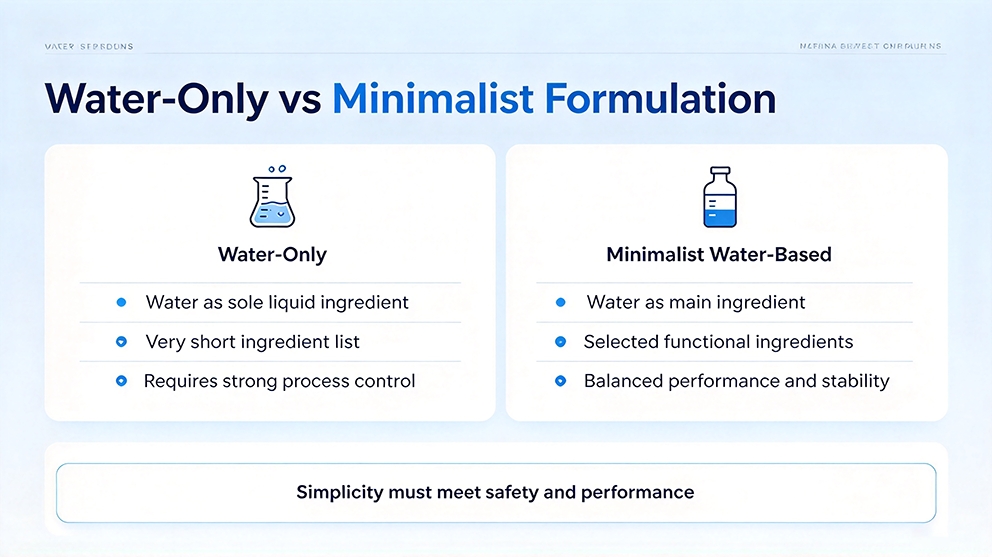
Water-only wet wipes are wipes moistened with a liquid that contains water as the sole intentionally added formulation ingredient. Unlike conventional wet wipes, they do not deliberately include additional functional ingredients such as surfactants, preservatives, fragrances, botanical extracts, or moisturizers.
The concept appeals to brands that want to offer a product with a short and easy-to-understand ingredient list.
However, it is important to distinguish between three different product concepts.
1.1 Pure water-only wet wipes
These products are designed around water without intentionally added formulation additives. Their simplicity can appeal to consumers who want to minimize exposure to unnecessary ingredients.
Nevertheless, water alone does not provide the cleaning, moisturizing, or other specialized functions that additional ingredients may offer. More importantly, water-only formulations require careful microbiological risk assessment.
1.2 Wet wipes with a minimal water-based formulation
These wipes use water as the primary ingredient while including a small number of carefully selected functional ingredients.
Depending on the intended application, the formulation may include a preservative system, a mild cleansing agent, a humectant, or a pH-adjusting ingredient.
This approach can help manufacturers maintain a relatively simple ingredient list while meeting product performance and stability requirements.
1.3 Preservative-free wet wipes
Preservative-free wet wipes are not necessarily water-only products. They may contain other functional ingredients but exclude ingredients classified or declared as preservatives under the applicable regulatory framework.
Conversely, a product containing only water is not automatically microbiologically safe. Its safety depends on the manufacturing process, water quality, packaging, contamination controls, and conditions throughout its shelf life.
For manufacturers, these distinctions are essential when developing product specifications and making marketing claims.
2. Why Are Brands Interested in Water-Only Wet Wipes?
The demand for simplified formulations is driven by several consumer and market trends.
2.1 A shorter ingredient list
Consumers increasingly examine product labels before purchasing personal care products. A shorter ingredient list can be easier to understand and may help brands communicate a minimalist product concept.
For manufacturers, a water-only formulation may appear attractive because it eliminates the need to select and combine multiple functional ingredients.
However, fewer ingredients do not necessarily mean fewer manufacturing challenges. The formulation may be simpler, while the microbiological control and packaging validation requirements remain demanding.
2.2 A minimalist product positioning
Water-only wet wipes can appeal to brands that emphasize simplicity and avoid unnecessary additives.
This positioning may be particularly relevant to products intended for situations where consumers prefer a straightforward cleansing wipe without added fragrance or other optional ingredients.
Nevertheless, terms such as "natural," "clean," and "gentle" should be supported by appropriate product characteristics and evidence. They should not be used to imply that a water-only product is automatically safer than a properly formulated alternative.
2.3 No intentionally added fragrance
A water-only formulation does not require fragrance to provide a scent. This can be attractive to consumers who prefer unscented products.
It is important to distinguish "unscented" from "fragrance-free" when describing commercial products. An unscented product may contain ingredients used to mask other odors, whereas fragrance-free generally indicates that fragrance has not been intentionally added. The precise meaning depends on the product's formulation and labeling requirements.
2.4 A simplified formulation development process
Removing optional ingredients can reduce the number of formulation variables that need to be evaluated.
For example, manufacturers may not need to investigate fragrance solubility, interactions between multiple botanical extracts, or the compatibility of certain moisturizers.
However, water-only wet wipes still require testing of the water, substrate, packaging, production process, and finished product. A simple formula is not a substitute for a comprehensive product validation program.
3. Is Water Alone Enough for Wet Wipes?
The most important question is not whether water can wet a nonwoven fabric. Clearly, it can.
The real question is whether water alone can deliver the required product performance throughout the intended shelf life.
The answer depends on the application.
3.1 Water can provide basic wetting
Water is the main carrier in many wet wipes formulations. It distributes the liquid throughout the nonwoven substrate and provides moisture during use.
For simple wiping applications, water may provide adequate basic wetting. However, wetting a surface is not the same as effectively removing every type of soil, oil, or residue.
3.2 Water does not provide specialized cleansing functions
Water can remove some water-soluble dirt and loose particles through wiping. It is generally less effective at removing oily soils, sebum, makeup, and certain stubborn residues without the help of suitable cleansing ingredients.
For applications requiring enhanced cleaning performance, a mild surfactant or another functional ingredient may be necessary.
For example:
Baby wipes: Water provides moisture, but manufacturers must still assess skin contact, microbiological quality, and the intended cleansing performance.
Facial wipes: Water alone may not adequately remove sunscreen, makeup, or excess sebum.
Household cleaning wipes: Water may be insufficient for grease and other difficult soils.
Personal cleansing wipes: The appropriate formulation depends on the body area, intended use, and required performance.
A water-only formula should therefore be selected based on a defined product purpose rather than the assumption that fewer ingredients are always better.
3.3 Water does not automatically protect the product from microbial growth
This is one of the most important considerations.
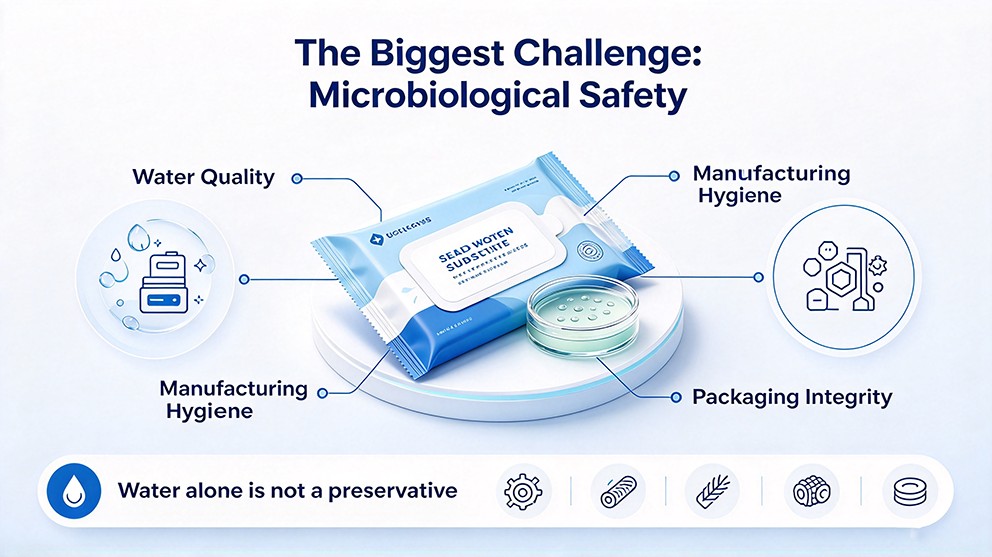
Water is not a preservative. When water is present in a wet wipe, microorganisms may be introduced through raw materials, equipment, the manufacturing environment, handling, or packaging operations.
If the product provides suitable conditions for microbial growth, contamination may develop during storage.
Even high-quality purified water can become contaminated after production if the process is not adequately controlled. Likewise, a clean-looking wipe and an odor-free liquid do not prove that a product is microbiologically safe.
For this reason, manufacturers should not assume that water-only wet wipes can achieve an acceptable shelf life simply by starting with clean water.
4. The Biggest Challenge: Microbiological Safety
For many manufacturers, microbiological control is the main technical challenge when developing water-only wet wipes.
A commercial wet wipe is a moisture-containing product that combines liquid, nonwoven material, packaging, and a manufacturing process. Each component can influence the overall microbiological risk.
4.1 Water quality is the starting point
The water used in wet wipes production should meet defined specifications appropriate to the product and manufacturing process.
Depending on the facility and application, water treatment may involve reverse osmosis, deionization, ultraviolet treatment, filtration, or other validated methods.
However, installing water purification equipment is not enough by itself. Manufacturers should establish routine monitoring and maintenance procedures, including appropriate microbiological testing.
Key considerations include:
Water treatment system performance.
Microbial quality of the water at the point of use.
Water storage tank hygiene.
Distribution pipework and potential biofilm formation.
Cleaning and sanitization procedures.
Sampling frequency and acceptance criteria.
Water quality should be managed as an ongoing process, not as a one-time test.
4.2 Manufacturing hygiene is equally important
Even if the water meets the required specifications, contamination may occur during liquid preparation, transfer, filling, or packaging.
Manufacturers should establish appropriate controls for tanks, pipelines, pumps, filling equipment, utensils, and product-contact surfaces.
Personnel hygiene, environmental cleanliness, equipment maintenance, and documented sanitation procedures also contribute to risk reduction.
The objective is to prevent contamination from entering the product and to minimize opportunities for microorganisms to multiply.
4.3 The nonwoven substrate must be considered
The nonwoven fabric is not simply a passive carrier. Its raw materials, production conditions, storage, and handling can influence the microbiological quality of the finished wipe.
Manufacturers should evaluate the substrate supplier's specifications, incoming quality controls, storage conditions, and compatibility with the proposed liquid.
The substrate must also provide suitable absorbency, strength, softness, and liquid distribution for the intended application.
4.4 Packaging is part of the safety system
Packaging helps protect wet wipes from external contamination and moisture loss during storage and use.
However, packaging should not be treated as a substitute for preservation or hygienic manufacturing. A sealed package does not automatically make a product sterile or prevent all microbial growth.
For water-only wipes, packaging selection and validation are especially important because the product may not contain a conventional preservative system.
Manufacturers should assess seal integrity, material compatibility, moisture retention, dispensing design, and the potential for contamination during repeated opening and use.
4.5 A longer shelf life creates additional challenges
A product that performs well immediately after production may not maintain the same microbiological quality after months of storage.
Temperature fluctuations, packaging performance, contamination introduced during manufacture, and the properties of the liquid-substrate combination can all influence product stability.
Therefore, a water-only wet wipe should not be assigned a commercial shelf life based solely on the ingredient list or initial test results.
Its shelf life should be supported by an appropriate, documented validation program.
5. Can Water-Only Wet Wipes Be Made Without Preservatives?
This question requires a careful distinction between technical possibility and commercial suitability.
Some water-only wet wipe concepts may be feasible under specifically designed manufacturing, packaging, and use conditions. However, a preservative-free formula should not be assumed safe without product-specific evidence.
Whether a product can be marketed without an intentionally added preservative depends on its intended use, manufacturing controls, packaging configuration, target shelf life, applicable regulations, and demonstrated microbiological performance.
5.1 Why removing preservatives is not enough
Preservatives are used in many water-based products to help control microbial growth. When a manufacturer removes a preservative system, the product loses one potential layer of protection.
The remaining controls must be evaluated carefully. These may include water quality, hygienic manufacturing, packaging, production controls, and other validated measures appropriate to the product.
It is not sufficient to say that the formula contains only water and therefore has fewer opportunities for contamination.
5.2 Is sterile water the solution?
Using appropriately controlled water is important, but starting with sterile or microbiologically controlled water does not guarantee that the finished product will remain free from contamination.
Microorganisms may be introduced by the substrate, equipment, filling environment, or packaging process. In addition, maintaining sterility throughout manufacturing and the product's entire shelf life requires a validated system.
A product made with sterile water should not automatically be described as sterile unless the finished product and the relevant manufacturing process meet the applicable requirements for that claim.
5.3 Could single-use packaging help?
Individually packaged wipes may reduce repeated exposure to the external environment compared with a multi-wipe pack that is opened many times.
However, single-use packaging does not eliminate contamination risks during manufacture, filling, sealing, and storage.
It should be considered one element of the overall product design rather than a guaranteed replacement for preservation.
5.4 What should manufacturers do before launching a preservative-free product?
A practical development process should include:
Defining the intended application and target consumer.
Conducting a product-specific microbiological risk assessment.
Establishing water, substrate, equipment, and environmental controls.
Selecting suitable packaging and validating its performance.
Defining microbiological acceptance criteria.
Conducting appropriate finished-product testing and stability studies.
Establishing a scientifically justified shelf life.
Reviewing applicable regulatory and labeling requirements.
Where relevant, a qualified microbiology laboratory should help determine which tests and validation approaches are appropriate.
The key principle is simple: the decision to exclude preservatives must be supported by evidence, not merely by a marketing preference.
6. Water-Only Wet Wipes vs. Minimalist Water-Based Formulations
For many brands, the most practical alternative to a water-only product is a minimalist water-based formulation.
This approach keeps water as the main ingredient while adding only those functional ingredients necessary to meet defined performance and safety requirements.
| Evaluation factor | Water-only formulation | Minimalist water-based formulation |
| Ingredient list | Very short | Short, with selected functional ingredients |
| Basic wetting | Possible | Possible |
| Removal of oily soils | May be limited | Can be improved with suitable cleansing agents |
| Moisturizing performance | Limited to the effects of water and wiping | Can be tailored with suitable humectants |
| Microbiological control | Requires a validated control strategy | Can include an appropriate preservative system |
| Fragrance | None intentionally added | Optional, depending on the product |
| Formulation flexibility | Limited | Greater flexibility |
| Development focus | Process, packaging, substrate, and microbial risk | Formula optimization plus process and microbial validation |
Neither option is automatically superior in every situation.
Water-only wipes may suit a narrowly defined product concept where the intended performance and validated controls support that design. A minimalist water-based formulation may be more suitable when the product needs additional cleansing, moisturizing, or preservation functions.
The best choice is the one that meets the product brief while maintaining appropriate quality and safety throughout its intended life cycle.
7. What Ingredients Might Be Needed in a Natural Wet Wipes Formula?
If a brand wants a product that is mostly water but does not require a strictly water-only ingredient list, several ingredient categories may be considered.
The exact selection depends on the product type, target market, ingredient restrictions, performance requirements, and regulatory framework.
7.1 Water
Water is usually the primary component of water-based wet wipes liquids.
Its quality, storage, and handling directly influence formulation consistency and microbiological risk.
Manufacturers should establish suitable specifications for the water used in production and verify that the water system remains under control.
7.2 Mild cleansing agents
A suitable surfactant may help remove dirt, oils, and other residues that water alone cannot effectively remove.
For products intended for skin contact, the surfactant should be selected based on its intended application, compatibility, cleansing performance, and tolerance profile.
The objective is not to add surfactants unnecessarily. It is to use them when the required product performance justifies their inclusion.
7.3 Humectants
Ingredients such as glycerin may help retain moisture and influence the skin feel of a wipe.
However, humectants are not automatically necessary in every formulation. Their use and concentration should be assessed in relation to the intended application, residue, fabric feel, and other performance requirements.
7.4 Preservative systems
For many water-based wet wipes, an appropriate preservative system can help control microbial growth during storage and use.
The system must be selected for the actual formulation, substrate, packaging, target microorganisms, intended market, and regulatory requirements.
A preservative should not be chosen solely because it is popular or described as natural. Its suitability and effectiveness need to be established in the finished product.
7.5 pH-adjusting ingredients
Some wet wipes formulations require pH adjustment to meet product specifications or support ingredient performance.
A water-only product does not necessarily need a pH adjuster, and the pH of pure water is not a reliable standalone indicator of product quality or safety.
For formulations containing additional ingredients, pH should be assessed as part of the overall formulation design.
7.6 Botanical extracts and other natural-origin ingredients
Some brands want to include aloe vera, chamomile, or other botanical ingredients to support a particular product concept.
These ingredients can also introduce additional formulation variables, such as color changes, odor changes, raw-material variability, and microbiological considerations.
Their inclusion should therefore be based on a clear product objective rather than the assumption that more botanical ingredients automatically make a product better.
7.7 Does a natural formulation always need more ingredients?
No. A natural-positioned wet wipe does not need every possible functional ingredient.
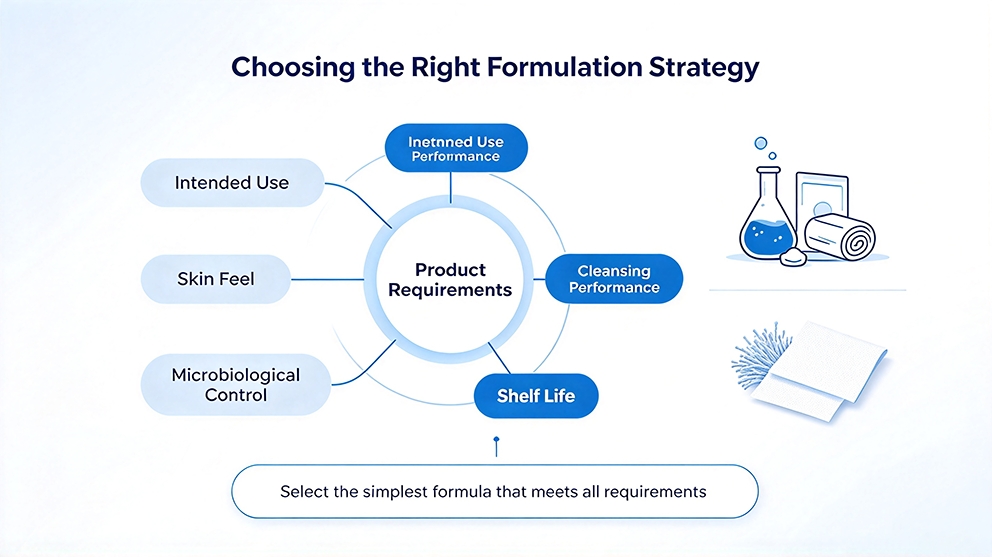
The most effective development strategy is to identify the product's essential requirements first and then select the simplest formulation that can reliably meet them.
A short ingredient list is a useful design objective only when it remains compatible with the product's performance and safety requirements.
8. How to Develop a Water-Only or Minimalist Wet Wipes Product
For wet wipes manufacturers and private-label brands, the following development process can help turn a product concept into a commercially viable product.
Step 1: Define the product application
Start by identifying the intended use.
Is the product designed for baby care, facial cleansing, personal hygiene, household cleaning, or another application?
The application determines the required cleansing performance, substrate characteristics, packaging design, testing strategy, and applicable regulatory requirements.
Step 2: Define what "water-only" means
Before development begins, the brand and manufacturer should agree on the exact formulation requirement.
Does the product need to contain only water as the intentionally added liquid ingredient? Is the objective simply to avoid fragrance? Or is the brand looking for a short ingredient list with no unnecessary additives?
These are different specifications and may lead to different technical solutions.
The parties should also clarify how the substrate and any processing aids are treated in the product's ingredient declarations and marketing claims.
Step 3: Evaluate the nonwoven substrate
The substrate should provide appropriate softness, absorbency, tensile strength, liquid retention, and dispensing performance.
A liquid that works well with one substrate may behave differently with another. The same applies to liquid distribution, residue, and the overall user experience.
Compatibility testing should therefore use the actual substrate intended for production.
Step 4: Establish the microbiological control strategy
This step should take place early, not after the formula has been finalized.
Define the water specifications, equipment hygiene requirements, production controls, packaging requirements, microbiological acceptance criteria, and testing program.
If the product is intended to be preservative-free, conduct a product-specific risk assessment to determine whether the proposed process and packaging can support the intended shelf life.
Step 5: Conduct laboratory and pilot testing
Evaluate the liquid and substrate together under realistic conditions.
Depending on the product, testing may cover liquid distribution, substrate strength, dispensing, moisture retention, odor, appearance, packaging compatibility, and microbiological quality.
Pilot production can help identify issues that may not be obvious during small-scale laboratory development.
Step 6: Validate stability and shelf life
The finished product should be evaluated over the intended storage period using appropriate testing protocols.
Accelerated stability testing can provide useful preliminary information, but it should not automatically replace real-time stability data or other validation required to justify the shelf life.
Testing conditions and acceptance criteria should be established according to the product and the markets in which it will be sold.
Step 7: Review claims and regulatory requirements
Before launch, review the product's ingredient declaration, marketing language, safety documentation, and applicable requirements in each target market.
Claims such as "natural," "preservative-free," "pure water," "suitable for sensitive skin," and "sterile" have different meanings and evidentiary requirements.
Claims should accurately describe the finished product and be supported by appropriate documentation.
9. Common Mistakes When Developing Water-Only Wet Wipes
Mistake 1: Assuming fewer ingredients mean a safer product
A shorter ingredient list may simplify certain aspects of formulation review, but it does not remove microbiological risks.
Water quality, equipment hygiene, substrate quality, packaging, and finished-product testing remain important.
Mistake 2: Assuming purified water stays clean automatically
Water quality can change during storage and distribution. Poorly maintained tanks or pipework may become sources of contamination.
A water treatment system should be supported by maintenance, sanitation, monitoring, and documented procedures.
Mistake 3: Selecting packaging without evaluating the full system
A package that prevents visible leakage may still be unsuitable for the product's intended shelf life or dispensing requirements.
Packaging must be assessed together with the liquid, substrate, filling process, sealing method, and intended use.
Mistake 4: Treating preservative-free as a synonym for natural
"Natural" and "preservative-free" describe different product attributes. Neither term alone demonstrates safety, efficacy, or suitability for a particular user group.
Brands should define the exact claims they want to make and confirm that the finished product meets the relevant criteria.
Mistake 5: Skipping finished-product testing
Testing the water alone does not demonstrate the microbiological quality or stability of the finished wet wipe.
The actual product—including the liquid, nonwoven substrate, and packaging—must be evaluated using a suitable validation plan.
Mistake 6: Choosing a shelf life based on competitor products
A competing brand's shelf life cannot simply be transferred to a new product.
Differences in manufacturing processes, substrates, packaging, water systems, and preservation strategies can produce different outcomes. Shelf life should be justified by evidence from the product being marketed.
10. Is Water-Only the Best Choice for Natural Baby Wipes?
Baby wipes are an important application for water-focused formulations because parents often prioritize simple ingredient lists and products designed for delicate skin.
However, the suitability of a water-only baby wipe depends on more than the presence or absence of additives.
Manufacturers should consider the intended use, frequency of use, skin contact, cleaning performance, substrate softness, packaging, microbiological risk, and relevant regulatory requirements.
A product designed for routine baby care must be evaluated as a complete finished product. The use of water alone does not establish that it is safer or more suitable for babies than a well-formulated alternative.
For some brands, a carefully developed water-only concept may be appropriate. For others, a minimalist formulation containing water and selected functional ingredients may provide a better balance between a simple ingredient list, product performance, and microbiological control.
The correct decision should be based on product-specific evidence rather than marketing trends alone.
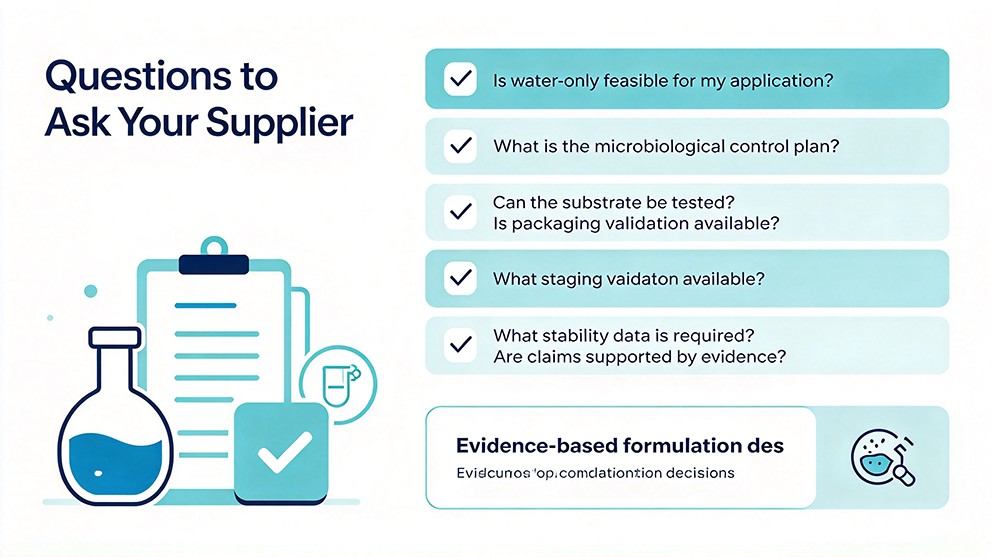
11. How Can Wet Wipes Manufacturers Choose the Right Formulation Strategy?
For B2B manufacturers and private-label brands, formulation decisions should begin with the commercial product brief.
Consider the following questions:
What is the intended use of the wet wipe?
Is a strictly water-only ingredient list essential, or is a minimalist formulation acceptable?
What level of cleansing performance is required?
Is the product intended to be fragrance-free?
What substrate and packaging will be used?
What shelf life and storage conditions are required?
What microbiological specifications and validation procedures are appropriate?
Which markets will the product enter, and what claims will be made?
Once these requirements are clear, the development team can determine whether water alone is a reasonable option or whether selected functional ingredients are needed.
A good formulation strategy does not focus exclusively on minimizing ingredients. It aims to achieve the desired product characteristics while maintaining quality, safety, and consistency.
12. Work with a Wet Wipes Liquid Formulation Supplier
Developing a water-only or minimalist wet wipes product requires coordination between the liquid formulation, nonwoven substrate, manufacturing process, packaging, and quality-control program.
For wet wipes manufacturers, working with an experienced wet wipes liquid supplier can help clarify the technical requirements before production begins.
A formulation partner can assist with:
Evaluating the feasibility of water-only and minimalist formulations.
Selecting functional ingredients based on the product's intended use.
Assessing liquid-substrate compatibility.
Reviewing preservative options and microbiological control considerations.
Supporting formulation optimization and laboratory testing.
Identifying stability and packaging compatibility risks.
Developing customized wet wipes liquids for different product categories.
The final formulation should be tailored to the manufacturer's production conditions, product specifications, and target market. No single formula is suitable for every wet wipe application.
At WipesLiquid, we understand that wet wipes manufacturers need more than a list of ingredients. They need formulation solutions that align with their product concepts, manufacturing processes, and customer expectations.
If you are developing natural baby wipes, water-based personal care wipes, or other minimalist wet wipes products, contact our team to discuss your formulation requirements and explore a suitable development approach.
Conclusion: Can Natural Wet Wipes Be Made with Water Only?
Yes, water-only wet wipes may be technically feasible for certain product concepts. However, the decision requires careful evaluation of the intended use, manufacturing process, substrate, packaging, microbiological controls, and expected shelf life.
Water provides moisture and can support basic wiping performance, but it does not automatically provide enhanced cleansing, moisturizing, or microbial protection.
For many commercial applications, a minimalist water-based formulation may offer a more practical balance between a simple ingredient list and the functional requirements of the finished product.
For wet wipes manufacturers, the most important principle is to choose the simplest formulation that can consistently meet the product's performance, quality, and safety requirements.
A successful natural wet wipes product is not defined by how few ingredients it contains alone. It is defined by how well the complete product performs throughout its intended life cycle.