





 English
 USA
USA
 西班牙语
西班牙语
 俄罗斯
俄罗斯
 葡萄牙
葡萄牙
 印尼
印尼
 巴基斯坦
巴基斯坦
 尼日利亚
尼日利亚
 孟加拉
孟加拉
 墨西哥
墨西哥
 越南
越南
 日本
日本
 韩国
韩国
 沙特阿拉伯
沙特阿拉伯

As temperatures begin to drop, down jackets and other padded winter garments are becoming essential everyday clothing.
During the autumn and winter seasons, down jackets are frequently exposed to dust, food stains, makeup, sweat, skin oils, mud and other surface contaminants. However, many consumers do not want to wash an entire down jacket every time a small stain appears.
This has created growing demand for down jacket cleaning wipes—convenient wipes designed to remove localized stains from down jackets, puffer jackets and other winter garments.
For wet wipes manufacturers and household cleaning product brands, this product category offers an attractive seasonal opportunity.
But developing a good down jacket cleaning wipes liquid is not as simple as adding a conventional detergent to a wet wipe.
The formulation needs to provide sufficient cleaning performance while minimizing residue, excessive foaming, fabric damage and undesirable changes in the appearance or feel of the garment.
This article explains the key considerations when developing a down jacket cleaning wipes liquid formulation for commercial production.
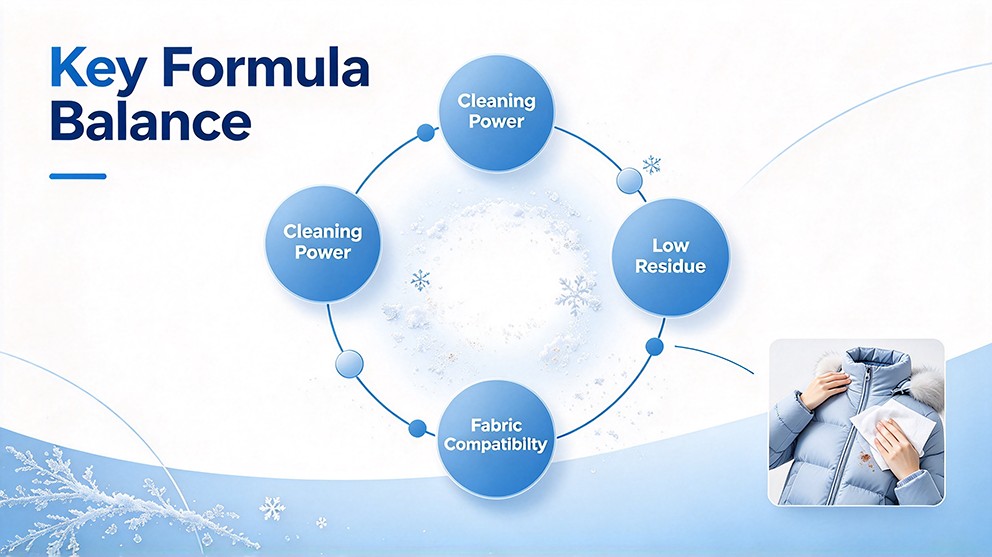
What Are Down Jacket Cleaning Wipes?
Down jacket cleaning wipes are pre-moistened wipes designed for quick, localized cleaning of the outer surface of down jackets and similar garments.
Unlike conventional laundry detergent, these wipes are generally intended for spot cleaning rather than complete garment washing.
Typical applications include removing:
Food stains
Coffee or beverage stains
Dust
Fingerprints
Makeup
Sweat marks
Collar stains
Cuff stains
Light grease and oil
Everyday surface dirt
The main advantage is convenience.
A consumer can clean a small stained area without putting the entire jacket through a washing process.
This makes down jacket cleaning wipes particularly attractive for:
Daily commuting
Outdoor activities
Travel
Business trips
School use
Family clothing care
Winter sports
Emergency stain removal
Why Down Jackets Require a Specialized Cleaning Solution
A down jacket is not simply an ordinary piece of clothing.
The garment may contain:
Down
Feathers
Nylon
Polyester
Coated fabrics
Water-repellent finishes
Laminated materials
Decorative components
Different types of stitching
The down filling provides insulation by trapping air, so maintaining the loft and performance of the filling is an important part of garment care.
At the same time, the outer shell may have its own finishing treatment.
For this reason, manufacturers should not assume that a conventional household cleaning wipe is automatically suitable for down jackets.
Garment-care guidance from brands such as UNIQLO and outdoor manufacturers generally emphasizes following the care label and using appropriate mild cleaning products for down garments.
This creates a specific formulation challenge:
The cleaning liquid needs to remove surface dirt without creating unnecessary residue or being excessively aggressive toward the garment.
Down Jacket Cleaning Wipes vs. Conventional Cleaning Wipes
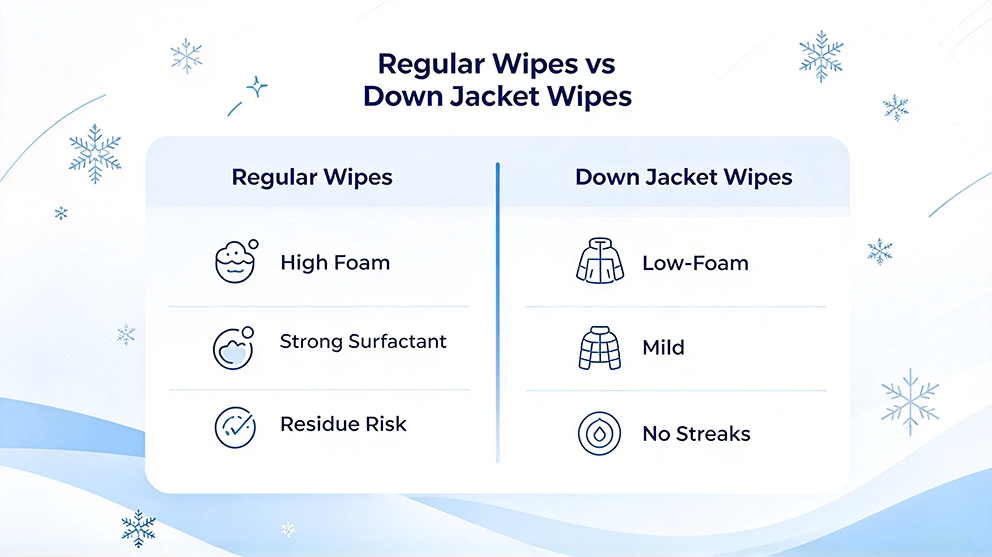
A general-purpose household cleaning wipe may be designed primarily for hard surfaces.
Its formulation may prioritize:
Strong detergency
High grease removal
High surfactant concentration
Strong alkalinity
Fragrance
Disinfection
These characteristics are not necessarily ideal for clothing.
Down jacket cleaning wipes have a different objective.
The formulation should focus on:
Effective but controlled cleaning
Mild surfactants
Low foam
Low residue
Good wetting
Good stain lifting
Easy wiping
Suitable fabric compatibility
Pleasant after-feel
The goal is not to make the strongest possible cleaner.
The goal is to create a balanced textile-cleaning formulation.
Key Requirements for a Down Jacket Cleaning Wipes Liquid
A well-designed formulation should generally address several important properties.
1. Cleaning Performance
The primary purpose is stain removal.
The liquid should help loosen and remove common surface contaminants such as:
Dust
Sweat
Sebum
Food residue
Beverage stains
Light grease
Makeup
Surfactants are typically an important part of this process.
2. Low-Foam Performance
Low foam is particularly useful for cleaning wipes.
Unlike laundry detergent, the liquid is not being diluted and rinsed through a washing machine.
The user usually:
Wipes → Removes the stain → Leaves the garment to dry
Excessive foam can therefore be inconvenient.
It can also increase the amount of residue left on the fabric.
For this reason, low-foam or controlled-foam surfactant systems can be advantageous for down jacket cleaning wipes.
3. Low Residue
This is one of the most important characteristics.
After using a wet wipe, the consumer generally does not rinse the entire jacket.
Therefore, the cleaning solution should ideally leave as little undesirable residue as possible.
Excessive residue may cause:
Visible marks
Sticky feel
Uneven appearance
Stiffness
Attraction of dust
Changes in fabric hand feel
This means that cleaning power should not be considered separately from rinse-free performance.
A good formulation needs to answer two questions:
Can it remove the stain?
and
What does it leave behind after wiping?
4. Good Wetting and Penetration
A cleaning wipe needs to distribute the liquid effectively over the contaminated area.
Good wetting can help the formulation
Contact the stain
Spread across the surface
Loosen contaminants
Transfer the dirt onto the wipe
However, excessive penetration into the garment is not necessarily desirable.
For spot-cleaning products, the objective is usually controlled surface cleaning rather than soaking the entire garment.
5. Mildness and Fabric Compatibility
Down jackets can contain sensitive outer fabrics and special finishes.
Some garments may also contain coatings or water-repellent treatments.
Therefore, a formulation should be evaluated for compatibility with the intended fabric types.
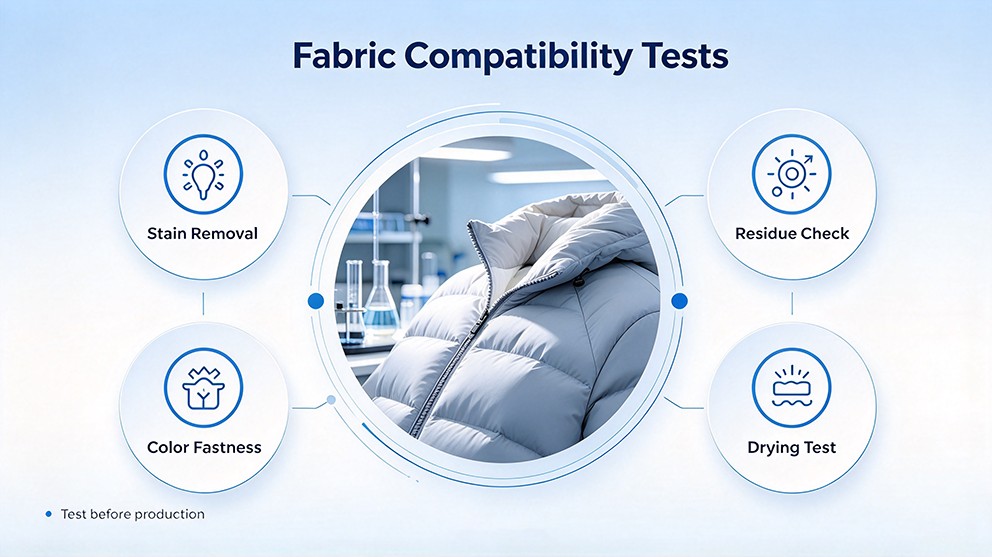
Manufacturers should test the finished wipe on representative materials rather than relying only on laboratory formulation data.
Recommended evaluation may include:
Color change
Surface appearance
Water repellency
Fabric hand feel
Residue
Gloss change
Streaking
Drying appearance
The specific tests should depend on the intended product and claims.
6. Appropriate pH
pH is another important formulation parameter.
A down jacket cleaning wipe should generally avoid unnecessarily aggressive alkalinity or acidity.
The exact target pH should be determined according to the formulation, raw materials, intended fabrics and product positioning.
Publicly available technical literature on down-jacket surface cleaning wipes includes formulations designed around a mildly alkaline pH range, illustrating that pH is a deliberate formulation parameter rather than an arbitrary number.
However, manufacturers should not simply copy a pH value from another product.
The complete formulation and fabric compatibility need to be evaluated together.
7. Suitable Surfactants
Surfactants are the main cleaning components in many down jacket cleaning wipe formulations.
Different surfactants provide different properties.
Potential categories include:
Nonionic Surfactants
Nonionic surfactants can provide effective cleaning and wetting while offering good formulation flexibility.
They are often considered for formulations where controlled foam and fabric compatibility are important.
Alkyl Polyglucosides (APG)
APG surfactants are frequently considered for cleaning products where mildness and a modern formulation concept are desired.
They can provide:
Cleaning
Wetting
Solubilization
Good formulation compatibility
Our own technical content on clothing-cleaning wet wipes also discusses APG-based systems combined with low-foam surfactants for clothing cleaning applications.
Mild Specialty Surfactants
Depending on the target product, manufacturers may also evaluate amino-acid-based or other mild surfactants.
The objective is not necessarily to use the highest surfactant concentration.
Instead, the formulation should achieve an appropriate balance between:
Cleaning Power + Low Foam + Low Residue + Fabric Compatibility
8. Why Surfactant Concentration Matters
More surfactant does not automatically mean better cleaning.
If the surfactant concentration is too low, the product may have insufficient cleaning power.
If it is too high, the product may potentially create:
Excess foam
Increased residue
Sticky feel
Difficult wiping
Poor appearance after drying
Therefore, formulation optimization is essential.
A good down jacket cleaning wipe should use an appropriate surfactant system rather than simply maximizing the active concentration.
9. Chelating Agents and Formulation Stability
Chelating agents may be considered in some formulations to help control metal ions and improve formulation stability.
Depending on the formulation, ingredients such as citrate or EDTA derivatives may be evaluated.
Their role can include:
Supporting formulation stability
Improving cleaning performance under certain water conditions
Helping manage metal ions
However, ingredient selection should always be based on the complete formulation and the regulatory requirements of the target market.
10. Humectants and Skin Feel
Although the product is primarily designed for clothing, consumers may come into contact with the liquid during use.
Therefore, the sensory characteristics of the formulation can still be relevant.
A formulation may be designed to avoid:
Excessive stickiness
Greasiness
Strong chemical odor
Excessive foaming
The final liquid should ideally provide a clean wiping experience.
11. Fragrance Selection
Fragrance is another product-development decision.
A down jacket cleaning wipe may be positioned as:
Fragrance-free
Fresh scent
Light floral
Citrus
Herbal
Premium fragrance
However, fragrance should be used carefully.
A strong fragrance may mask odors temporarily without improving actual cleaning performance.
For premium clothing-care products, a light and clean fragrance profile may be more suitable than an overpowering perfume.
12. Should Down Jacket Cleaning Wipes Contain Alcohol?
This depends on the product positioning and formulation requirements.
Alcohol can contribute to quick evaporation and certain cleaning characteristics, but it is not automatically required for a down jacket cleaning wipe.
A water-based formulation without alcohol may be preferable for some textile-cleaning concepts.
The decision should consider:
Target fabric
Cleaning performance
Drying time
Odor
Flammability considerations
Regulatory requirements
Product positioning
Manufacturers should test the final formulation on the intended fabrics before commercial production.
13. Should Antibacterial Ingredients Be Added?
This depends on the intended claims and target market.
If the product is simply positioned as a down jacket cleaning wipe, a cleaning formulation may be sufficient.
If the product makes antibacterial or antimicrobial claims, additional formulation, testing and regulatory considerations may apply.
Manufacturers should not add antimicrobial ingredients simply because they appear attractive from a marketing perspective.
The ingredient, concentration, claim and target market must be considered together.
14. The Importance of the Nonwoven Fabric
The cleaning liquid is only one component of a wet wipe.
The nonwoven substrate is equally important.
For down jacket cleaning wipes, the fabric should ideally provide:
Soft wiping
Good liquid absorption
Good liquid release
Adequate strength
Low lint
Good stain pickup
Comfortable hand feel
Possible materials include different types of spunlace and other nonwoven substrates.
The best substrate depends on the intended product positioning and production equipment.
15. Liquid Add-On Ratio
The amount of liquid absorbed by the wipe can have a major impact on the finished product.
Too little liquid may result in:
Poor wiping performance
Dry feeling
Insufficient cleaning
Too much liquid may result in:
Excessive wetness
Longer drying time
Packaging leakage
Uneven liquid distribution
Excess liquid transfer onto clothing
Therefore, the liquid add-on ratio should be optimized during production trials.
For example, manufacturers can evaluate:
Nonwoven weight → Liquid pickup → Wiping performance → Drying time → Residue
This should be tested with the actual nonwoven material and wipe dimensions.
16. Cleaning Different Types of Stains
Not all stains behave in the same way.
A down jacket cleaning wipe may encounter:
Water-Soluble Stains
Examples include:
Coffee
Tea
Soft drinks
Light food residues
These may respond relatively well to water and suitable surfactants.
Oil-Based Stains
Examples include:
Sebum
Cosmetics
Grease
Oily food
These may require a stronger emulsification and surfactant system.
Particulate Dirt
Examples include:
Dust
Soil
Outdoor dirt
These may require effective wetting and mechanical wiping.
Therefore, product testing should use multiple stain types instead of evaluating the formula using only one standard stain.
17. How to Evaluate a Down Jacket Cleaning Wipe
A professional product-development program can evaluate several performance parameters.
Stain Removal
Measure how effectively the wipe removes standardized stains.
Residue
Observe the fabric after drying.
Color Change
Check whether the treated area changes color.
Streaking
Evaluate whether the wipe leaves visible lines or marks.
Hand Feel
Compare the treated and untreated areas.
Drying Time
Measure how quickly the treated area dries.
Water Repellency
If relevant to the garment, evaluate whether the cleaning treatment affects the surface's water-repellent performance.
Odor
Evaluate both the formulation odor and the odor after drying.
18. Why Spot Testing Is Essential
Before recommending a cleaning wipe for consumers, manufacturers should conduct spot testing.
This is especially important because down jackets can be made from different materials.
A suitable instruction may be:
Test the product on a small, inconspicuous area before full use. Always follow the garment manufacturer's care instructions.
This type of precaution is important because manufacturers cannot assume that every down jacket has identical fabric construction or finishing.
19. Down Jacket Wipes Are Not a Replacement for Full Washing
This distinction should be clear on the product label and marketing materials.
A cleaning wipe is primarily intended for:
quick surface cleaning and localized stain removal.
It is not necessarily intended to replace the complete washing process required for heavily soiled garments.
Consumers should follow the garment care label for complete cleaning.
Care guidance from major apparel and outdoor brands similarly emphasizes checking the care label and using appropriate cleaning methods for the specific garment.
20. Common Formulation Mistakes
When developing down jacket cleaning wipes, manufacturers should avoid several common mistakes.
Mistake 1: Using a Strong Household Cleaner
A strong cleaner may remove stains effectively but may not provide the desired textile compatibility.
Mistake 2: Using Too Much Surfactant
High surfactant concentration can increase foam and residue.
Mistake 3: Ignoring Residue
A product can have excellent stain removal but still perform poorly if it leaves visible marks after drying.
Mistake 4: Ignoring Fabric Compatibility
Testing only on one fabric is not sufficient for a product intended for multiple garment types.
Mistake 5: Excessive Fragrance
A strong fragrance does not equal better cleaning performance.
Mistake 6: Excessive Liquid Loading
Too much liquid can make the wipe inconvenient and increase packaging problems.
Mistake 7: Making Unsupported Claims
Claims such as "safe for all fabrics" or "will never damage down jackets" should be avoided unless properly supported.
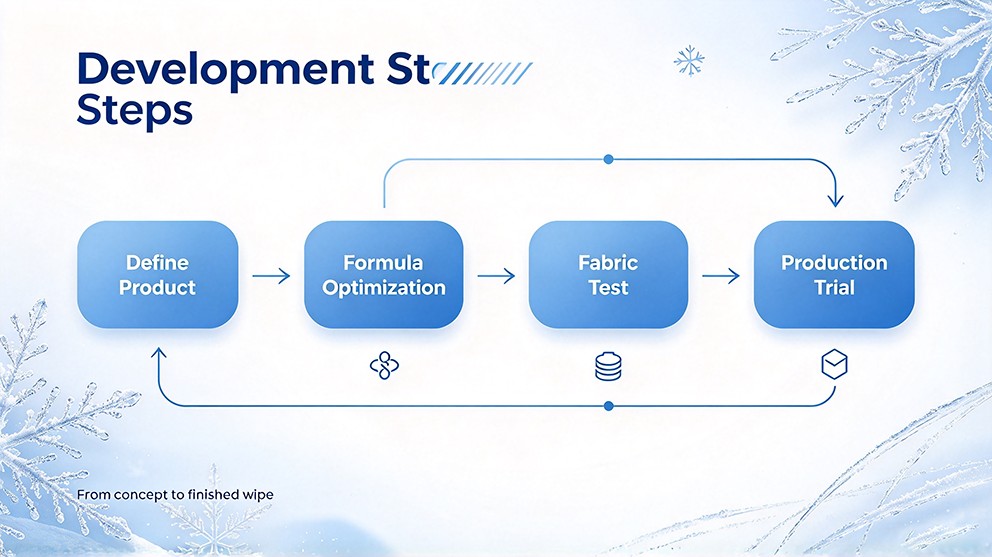
21. Recommended Development Process for Down Jacket Cleaning Wipes
For wet wipes manufacturers developing a new product, a structured development process is recommended.
Step 1: Define the Product Positioning
Decide whether the product is intended for:
Down jackets
Puffer jackets
Outdoor clothing
Sportswear
General winter clothing
Step 2: Define the Cleaning Target
Determine which stains the product should address.
Step 3: Select the Surfactant System
Evaluate mild, low-foam surfactants with appropriate cleaning performance.
Step 4: Optimize pH
Select a suitable pH based on the complete formulation and intended textile applications.
Step 5: Optimize Residue
Evaluate the appearance and hand feel after drying.
Step 6: Select the Nonwoven
Match the liquid formulation with the actual substrate.
Step 7: Conduct Fabric Compatibility Testing
Test on representative jacket materials.
Step 8: Conduct Production Trials
Run the formulation through the actual wet wipes manufacturing line.
Step 9: Evaluate Finished Product Stability
Evaluate the packaged wipes during the intended storage period.
Step 10: Confirm Regulatory Requirements
Review requirements in the target sales market before commercial launch.
22. What Should Manufacturers Ask a Down Jacket Cleaning Wipes Liquid Supplier?
Before purchasing a formulation, manufacturers should ask the supplier:
1. Is the liquid specifically designed for textile cleaning?
2. What surfactant system is used?
3. What is the recommended pH?
4. Is the formulation low-foam?
5. What is the recommended liquid add-on ratio?
6. Has the formulation been tested on down jacket fabrics?
7. Does the formulation leave visible residue after drying?
8. Can the formulation be customized?
9. Can the supplier provide a TDS and COA?
10. Can samples be provided for production testing?
11. Can the formulation be adjusted for different stain types?
12. Can fragrance-free and scented versions be developed?
These questions help buyers evaluate the supplier from both a technical and commercial perspective.
23. Why Low-Foam Formulation Is Particularly Important for Cleaning Wipes
Traditional laundry detergents are designed for a washing process.
The product is diluted with water, circulated mechanically and then rinsed.
Cleaning wipes work differently.
The cleaning liquid is:
Applied → Wiped → Transferred to the substrate → Left to dry
There is usually no full rinse step.
Therefore, excessive foam is not particularly useful.
A low-foam formulation can make the wiping process more convenient and may help reduce visible residue.
This is one reason why clothing-cleaning wet wipe formulations often require a different surfactant balance from conventional laundry detergents.
24. The Role of APG in Down Jacket Cleaning Wipes
Alkyl Polyglucosides, commonly known as APG surfactants, are one formulation option worth evaluating for textile cleaning wipes.
APG can provide:
Wetting
Cleaning
Emulsification
Solubilization
Good formulation compatibility
For clothing-cleaning wet wipes, APG can be combined with other surfactants to create a balanced cleaning system.
The objective is not simply to maximize APG concentration.
Instead, formulators need to optimize the overall system based on:
Cleaning Power + Foam + Residue + Fabric Compatibility + Cost
This balance is particularly important for commercial wet wipes production.
25. Developing an Eco-Friendly Down Jacket Cleaning Wipe
Sustainability is becoming increasingly important in household cleaning and textile-care products.
Manufacturers may consider:
Biodegradable or readily biodegradable surfactants where appropriate
Plant-derived surfactants
Reduced fragrance
Minimal unnecessary ingredients
Sustainable nonwoven materials
Reduced packaging
Concentrated formulations where appropriate
However, "natural" does not automatically mean better.
The final formulation should still meet the required cleaning performance, stability and safety requirements.
26. Seasonal Opportunity for Wet Wipes Manufacturers
Down jacket cleaning wipes are particularly interesting because demand is strongly related to the autumn and winter seasons.
As temperatures fall, consumers begin using:
Down jackets
Puffer jackets
Ski clothing
Winter coats
Outdoor clothing
At the same time, people are more likely to notice stains around:
Collars
Sleeves
Cuffs
Pockets
Front panels
This creates a natural marketing opportunity for convenient spot-cleaning products.
For wet wipes manufacturers, the product can also be positioned alongside other seasonal cleaning products.
27. From Wet Wipes Liquid to Finished Product
Developing a successful down jacket cleaning wipe requires more than creating a cleaning formula.
The complete product includes:
Cleaning Formula
Nonwoven Fabric
Liquid Add-On Ratio
Wipe Size
Packaging
Production Process
Consumer Instructions
All of these elements influence the final user experience.
A good formula can still produce a poor product if the wipe substrate is unsuitable or the liquid loading is incorrectly controlled.
28. Customized Down Jacket Cleaning Wipes Liquid
Different customers may have different requirements.
For example:
Standard Down Jacket Cleaning Formula
Designed for everyday spot cleaning.
Low-Foam Formula
Designed for convenient wiping and low residue.
Fragrance-Free Formula
Designed for consumers who prefer a simple product concept.
Fresh Fragrance Formula
Designed for a pleasant post-cleaning experience.
Eco-Oriented Formula
Designed around selected plant-derived or biodegradable surfactants.
Premium Formula
Designed with additional conditioning and sensory considerations.
A professional supplier should be able to adjust the formulation according to the customer's product concept rather than offering only one fixed formula.
29. Why Choose a Specialized Wet Wipes Liquid Supplier?
For manufacturers entering the down jacket cleaning wipes market, choosing an experienced liquid supplier can reduce development time.
A specialized supplier can help with:
Formula selection
Surfactant selection
pH adjustment
Low-foam optimization
Residue control
Fabric compatibility testing
Liquid add-on recommendations
Sample development
Production troubleshooting
Technical documentation
Customized formulations
This is particularly valuable for manufacturers who already have wet wipes equipment but want to add a new winter-season product.
30. Conclusion
Down jacket cleaning wipes represent an interesting seasonal opportunity for wet wipes manufacturers and household cleaning brands.
However, developing a successful product requires more than simply putting detergent into a wet wipe.
A good down jacket cleaning wipes liquid should balance:
Cleaning Performance
Low Foam
Low Residue
Fabric Compatibility
Appropriate pH
Good Wetting
Pleasant User Experience
Formulation Stability
The formulation should also be tested together with the actual nonwoven substrate and representative down-jacket fabrics.
Most importantly, the product should be positioned as a convenient solution for localized surface cleaning, while consumers should continue to follow the care instructions provided by the garment manufacturer.
For wet wipes manufacturers looking to develop a new winter clothing-care product, a professionally designed down jacket cleaning wipes liquid can provide a practical foundation for creating a convenient, differentiated and commercially attractive product.
Looking for Down Jacket Cleaning Wipes Liquid?
We provide wet wipes liquid formulations for clothing and textile cleaning applications, including down jacket cleaning wipes.
Our formulation development can focus on:
Effective stain removal
Low-foam performance
Low residue
Mild cleaning
Fabric compatibility
Fragrance-free or scented options
Customized surfactant systems
Different nonwoven substrates
OEM/ODM requirements
If you are planning to launch Down Jacket Cleaning Wipes, contact us with your target market, nonwoven material, wipe size and desired cleaning performance.
We can help you develop and optimize a suitable Down Jacket Cleaning Wipes Liquid for your production line.