





 English
 USA
USA
 西班牙语
西班牙语
 俄罗斯
俄罗斯
 葡萄牙
葡萄牙
 印尼
印尼
 巴基斯坦
巴基斯坦
 尼日利亚
尼日利亚
 孟加拉
孟加拉
 墨西哥
墨西哥
 越南
越南
 日本
日本
 韩国
韩国
 沙特阿拉伯
沙特阿拉伯

Recent reports in the United Kingdom regarding Burkholderia stabilis contamination associated with certain non-sterile alcohol-free wipes have attracted significant attention from wet wipes manufacturers, distributors and buyers.
For manufacturers and brands that use wet wipes liquids, this has also raised an important question:
Does Burkholderia contamination mean that the wet wipes liquid formulation itself is unsafe?
The answer requires a careful distinction between a formulation and microbial contamination of a finished product.
The presence of bacteria in a finished wet wipe does not automatically mean that the ingredients used to formulate the wet wipes liquid are themselves the source of the contamination.
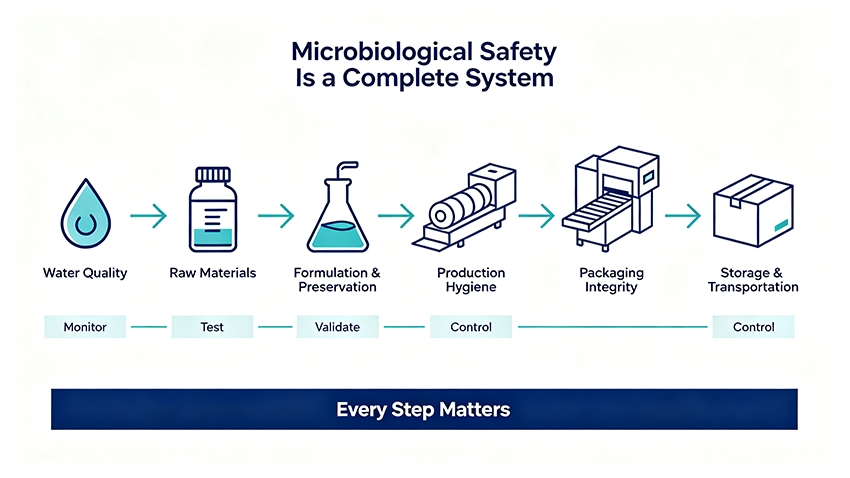
Microbiological safety is a complete manufacturing-system issue involving raw materials, water, formulation, preservation, production equipment, manufacturing environment, filling, packaging, storage and transportation.
Understanding this distinction is important for wet wipes manufacturers when evaluating recent contamination reports and selecting wet wipes liquid suppliers.
What Happened in the UK?
According to the UK Health Security Agency (UKHSA), an outbreak of Burkholderia stabilis in the UK was associated with certain non-sterile alcohol-free wipe products.
As of 3 February 2026, UKHSA reported 59 confirmed cases associated with several non-sterile alcohol-free wipe products. The affected products included:
ValueAid Alcohol Free Cleansing Wipes
Microsafe Moist Wipe Alcohol Free
Steroplast Sterowipe Alcohol Free Cleansing Wipes
Reliwipe Alcohol Free Cleansing Wipes
UK authorities advised that these specific products should not be used. The products had been withdrawn from sale. UKHSA also emphasized that non-sterile alcohol-free wipes should not be used for wound care or intravenous-line cleaning where sterile products are required. (GOV.UK)
This is an important point for the wet wipes industry:
The UK incident concerns contamination of specific finished wipe products. It should not automatically be interpreted as evidence that baby wipes liquid, cosmetic wet wipes liquid, or wet wipes formulations as a product category are inherently contaminated with Burkholderia.
Is Burkholderia Contamination Caused by Wet Wipes Liquid?
This is one of the most important questions for wet wipes manufacturers.
The short answer is:
Microbial contamination of a finished wet wipe cannot be attributed to the formulation alone without product-specific investigation and microbiological evidence.
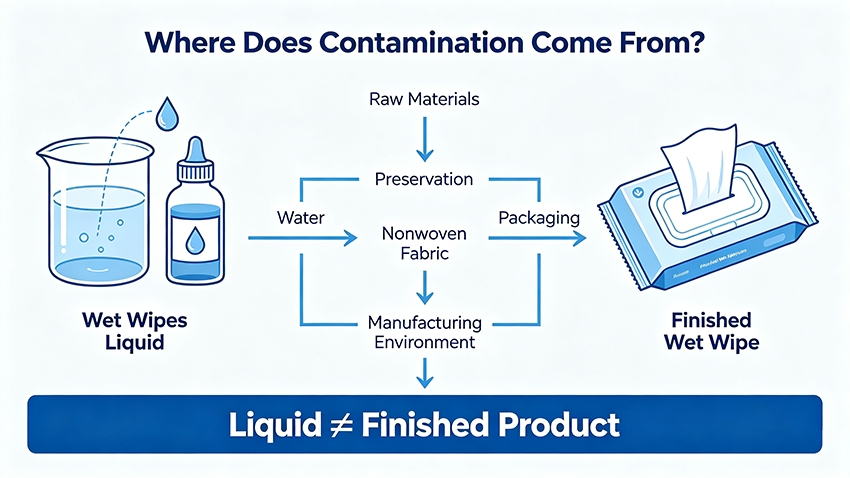
A wet wipe is not simply "liquid."
It is a complete product consisting of multiple components and manufacturing steps:
Water + raw materials + preservative system + nonwoven fabric + manufacturing equipment + production environment + packaging + storage + transportation
Any weakness in this chain can potentially affect the microbiological quality of the finished product.
For this reason, it is more accurate to discuss microbial contamination control throughout the entire production process rather than assume that the wet wipes liquid itself is responsible.
Wet Wipes Liquid and Finished Wet Wipes Are Not the Same Thing
This distinction is particularly important for international buyers.
A wet wipes liquid is a formulated water-based solution.
A finished wet wipe is a product in which the liquid is absorbed into a nonwoven substrate and then packaged.
The microbiological condition of the finished product depends on much more than the formula.
For example:
Wet Wipes Liquid
→ raw materials
→ purified water
→ preservative system
→ mixing process
→ storage tank
→ transfer system
Finished Wet Wipe
→ wet wipes liquid
→ nonwoven fabric
→ production equipment
→ production environment
→ filling process
→ packaging material
→ sealing
→ warehouse storage
→ transportation
Therefore, even if a liquid formulation is properly designed, manufacturers still need to control the subsequent production process.
How Can Microbial Contamination Enter a Wet Wipe?
Microbial contamination can occur through multiple potential routes.
The U.S. FDA, for example, identifies contaminated raw materials, water, ineffective preservation, inadequate packaging protection, poor manufacturing conditions, shipping and storage conditions as possible contributors to microbial contamination in water-based personal-care products. (U.S. Food and Drug Administration)
For wet wipes, the major areas requiring attention include the following.
1. Water Quality
Water is usually the largest component of a wet wipes liquid.
Therefore, water quality is extremely important.
If the water used during production is microbiologically unsuitable, it can introduce microorganisms into the formulation.
Professional wet wipes manufacturers should therefore control:
Purified water quality
Microbiological limits
Water treatment systems
Water storage tanks
Water distribution pipelines
Cleaning and sanitization procedures
The quality of the final liquid cannot be separated from the quality of the water used to manufacture it.
2. Raw Materials
Raw materials are another potential source of microorganisms.
A formulation may contain:
Humectants
Botanical extracts
Surfactants
Skin-conditioning ingredients
Preservatives
Chelating agents
pH adjusters
Other functional ingredients
Different raw materials have different microbiological characteristics.
For example, plant-derived ingredients and botanical extracts require appropriate quality control because they originate from biological or natural sources.
This is why reputable manufacturers should evaluate raw materials before they enter production.
3. Preservative System
Wet wipes contain a high percentage of water, making preservation an important part of formulation design.
A properly designed preservative system helps prevent microorganisms from multiplying during the intended shelf life.
However, preservation is not simply a matter of adding a preservative.
The effectiveness of a preservative system can depend on:
Preservative type
Concentration
pH
Water activity
Raw materials
Surfactants
Botanical extracts
Packaging
Manufacturing conditions
Therefore, the complete formulation needs to be evaluated.
A formulation that looks acceptable on paper should still be evaluated through appropriate microbiological and stability testing.
Does the Presence of a Preservative Guarantee That There Will Be No Bacteria?
No.
This is another common misunderstanding.
A preservative system is designed to control microbial growth. It does not mean that a product can never become contaminated under any circumstances.
For example, contamination can potentially occur because of:
Contaminated raw materials
Poor manufacturing hygiene
Contaminated production equipment
Inadequate water treatment
Improper storage
Damaged packaging
Inadequate preservation
Cross-contamination
Therefore, preservation and manufacturing hygiene must work together.
A high-quality wet wipes product requires a complete microbiological control system.
Why Manufacturing Conditions Matter
UKHSA has described product contamination as an emerging patient-safety concern and noted that contaminated products involved in incidents have often been non-sterile, water-based products. Its review included incidents involving wipes, gels and other water-based products. (GOV.UK)
This reinforces an important principle:
Microbiological safety is a manufacturing-system issue, not simply an ingredient issue.
A manufacturer may have a technically sound formulation, but poor control of production equipment or the manufacturing environment can still create a contamination risk.
Important production controls include:
Cleaning procedures
Equipment sanitation
Personnel hygiene
Environmental control
Water system maintenance
Tank cleaning
Pipeline sanitation
Production-line hygiene
Proper filling procedures
Packaging integrity
What About Burkholderia Specifically?
Burkholderia species are environmental microorganisms that can be found in natural environments, including water and soil.
UKHSA states that Burkholderia stabilis rarely causes infection in healthy people, while certain vulnerable groups face higher risks. UKHSA identified patients with intravenous devices, immunocompromised individuals and people with certain conditions such as cystic fibrosis among groups at higher risk. (GOV.UK)
This is particularly relevant because the UK outbreak involved non-sterile wipes used in contexts including skin cleansing, wound care and first-aid applications.
A key lesson for manufacturers is therefore:
The intended use of a wipe matters.
A cosmetic or general hygiene wipe is not automatically equivalent to a sterile medical product.
Products intended for use on wounds, broken skin or invasive medical applications may have substantially different requirements from ordinary cosmetic or personal-care wipes.
Non-Sterile Does Not Mean "Contaminated"
Another important distinction is between:
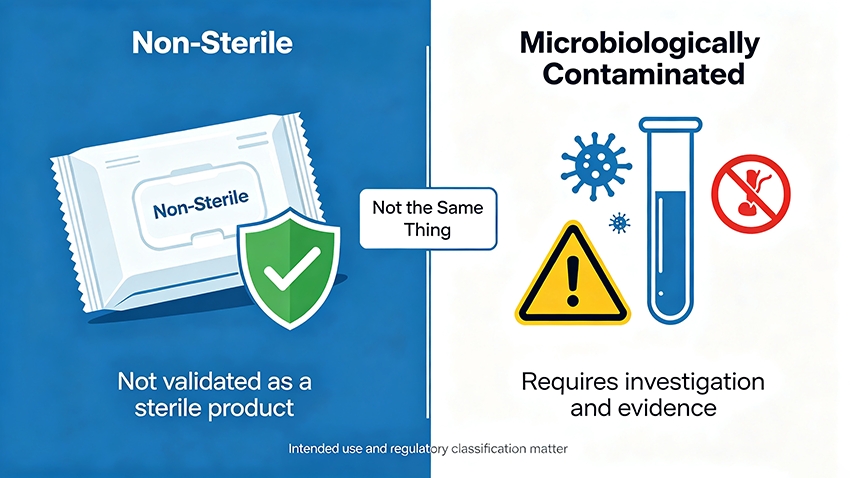
Non-sterile
and
Microbiologically contaminated
They are not the same concept.
A non-sterile product is not necessarily contaminated with a pathogenic microorganism.
"Non-sterile" generally means that the product has not been manufactured and validated as a sterile product.
However, non-sterile products still need to meet applicable microbiological quality and safety requirements for their intended use.
This is why the product's intended application and regulatory classification are so important.
Cosmetic Wet Wipes and Medical Wipes Should Not Be Confused
Manufacturers and buyers should clearly distinguish between different types of wipes.
Cosmetic / Personal-Care Wet Wipes
Examples include:
Baby wipes
Facial wipes
Makeup-removing wipes
Personal cleansing wipes
General hygiene wipes
Medical / Healthcare Wipes
Examples may include:
Wound-care wipes
Wipes intended for invasive-device care
Certain clinical cleansing products
Products making specific medical claims
The regulatory requirements, microbiological specifications and manufacturing expectations can differ significantly.
Therefore, a buyer should always define the intended use before selecting a formulation.
What Should Wet Wipes Manufacturers Do?
The UK contamination reports provide an opportunity for manufacturers to strengthen their quality-control systems.
A professional manufacturer should consider a comprehensive approach.
Step 1: Control Raw Materials
Select qualified raw-material suppliers and establish appropriate incoming quality controls.
Step 2: Control Water Quality
Use appropriately treated water and monitor its microbiological quality.
Step 3: Validate the Formulation
Evaluate the formulation's stability and preservation performance.
Step 4: Control Production Hygiene
Establish appropriate cleaning, sanitation and personnel hygiene procedures.
Step 5: Test the Bulk Liquid
The liquid should be evaluated according to the manufacturer's applicable microbiological specifications.
Step 6: Test the Finished Wet Wipe
The final product should also be evaluated because contamination can occur during the manufacturing and packaging process.
Step 7: Check Packaging Integrity
Packaging should protect the product throughout its intended shelf life.
Step 8: Monitor Storage and Transportation
Temperature, humidity and storage conditions should be appropriately controlled.
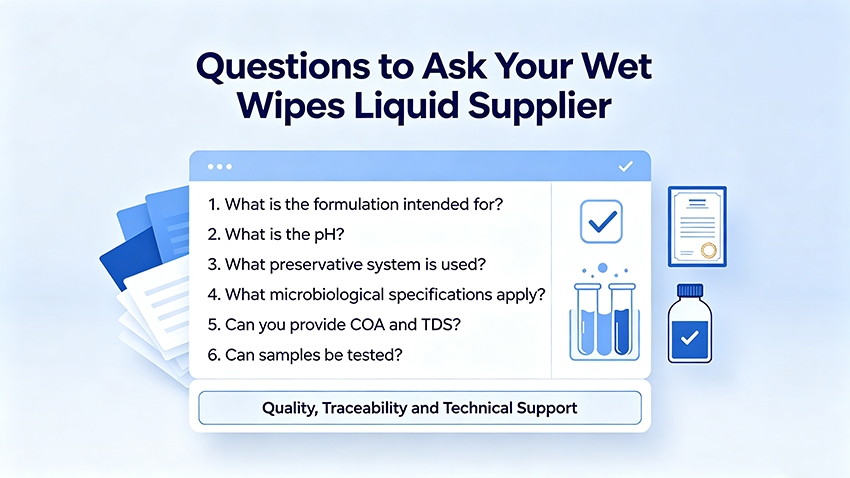
What Should Buyers Ask Their Wet Wipes Liquid Supplier?
If you are purchasing wet wipes liquid for commercial production, it is reasonable to ask the supplier for technical information.
For example:
1. What is the formulation intended for?
Baby wipes, personal cleansing wipes, facial wipes or another application?
2. What is the recommended dosage?
The liquid add-on ratio can affect the final product.
3. What is the pH?
The pH should be appropriate for the intended application.
4. What preservative system is used?
The supplier should be able to provide relevant technical information.
5. What microbiological specifications apply?
This helps the buyer understand the quality-control requirements.
6. Can you provide a COA?
A Certificate of Analysis can provide batch-specific quality information where applicable.
7. Can you provide a TDS?
The Technical Data Sheet provides information about product specifications and recommended use.
8. Can samples be tested before bulk purchasing?
Sample testing is particularly important for new formulations.
Why the Finished Product Must Also Be Tested
This is perhaps the most important message for manufacturers.
Even if a wet wipes liquid is tested before shipment, the manufacturer should not assume that the finished wipes will automatically have the same microbiological quality.
The production process can introduce additional variables.
For example:
Liquid → Mixing → Storage → Transfer → Nonwoven Saturation → Folding → Cutting → Packaging → Sealing → Storage
Every step needs appropriate control.
Therefore, finished-product testing remains an important part of quality management.
What Does This Mean for Baby Wipes Liquid?
For baby wipes manufacturers, the UK situation should not be interpreted as meaning that baby wipes liquid formulations are inherently unsafe.
Instead, it highlights the importance of selecting a professionally developed formulation and implementing appropriate manufacturing controls.
A well-designed baby wipes liquid should be evaluated for:
Ingredient quality
Water quality
pH
Preservation
Microbiological quality
Stability
Nonwoven compatibility
Recommended dosage
Packaging compatibility
Manufacturers should also ensure that their own production environment and finished products are properly controlled.
Choosing a Wet Wipes Liquid Supplier After the UK Contamination Reports
The recent UK situation makes supplier qualification more important, not less.
When comparing suppliers, manufacturers should look beyond price.
Consider:
Formulation Quality
Is the formulation specifically developed for the intended application?
Raw Material Quality
Are the raw materials controlled and traceable?
Preservation System
Has the preservation system been appropriately evaluated?
Technical Documentation
Can the supplier provide relevant specifications and certificates?
Production Experience
Does the supplier understand wet wipes manufacturing?
Technical Support
Can the supplier help troubleshoot formulation and production issues?
Customization
Can the formulation be adjusted according to the customer's market and application?
These factors can help buyers establish a more complete quality-control system.
The Key Point: Formula and Manufacturing Must Work Together
The recent Burkholderia cases demonstrate why microbiological safety should be viewed from a complete-system perspective.
It would be inaccurate to simplify a contamination incident into:
"There is bacteria in the finished wipe → therefore the wet wipes liquid formulation is the cause."
A more appropriate quality-control approach is:
Raw Materials + Water + Formulation + Preservation + Equipment + Manufacturing Environment + Packaging + Storage = Finished Product Microbiological Quality
Every part of this system matters.
The wet wipes liquid is an important component, but it is only one part of the final product.
Our Approach to Wet Wipes Liquid Quality
At Huaqiangda company, we understand that wet wipes liquid is not simply a mixture of ingredients.
For wet wipes manufacturers, the formulation needs to work together with the nonwoven fabric, production process, packaging and target market.
Our wet wipes liquid solutions can be developed for different applications, including:
Baby Wipes Liquid
Sensitive Skin Wipes Liquid
Personal Cleansing Wipes Liquid
Facial Wipes Liquid
Makeup Remover Wipes Liquid
Cleaning Wipes Liquid
Customized Wet Wipes Liquid
Depending on the application, formulations can be developed around requirements such as mildness, moisturizing feel, botanical extracts, fragrance-free concepts and appropriate preservation systems.
We also recommend that customers conduct sample testing and finished-product evaluation before commercial production.
Conclusion
The recent UK reports concerning Burkholderia stabilis contamination of certain non-sterile alcohol-free wipes are an important reminder of the need for strong microbiological quality control in the wet wipes industry.
However, the presence of Burkholderia in a finished wipe should not automatically be interpreted as evidence that the wet wipes liquid formulation itself is the cause.
Microbial contamination can involve multiple stages, including raw materials, water, formulation, preservation, production equipment, manufacturing hygiene, packaging, storage and transportation.
For wet wipes manufacturers, the most important approach is therefore not simply to change the liquid formulation, but to establish a complete microbiological quality-control system from raw materials to finished products.
By selecting qualified suppliers, using appropriate formulations, controlling water and manufacturing conditions, evaluating preservation, and testing finished products, manufacturers can significantly strengthen their product-quality management.
If you are concerned about the microbiological quality of your current wet wipes liquid, contact us to discuss your formulation, application and quality-control requirements.
We can provide technical information and sample support for manufacturers developing baby wipes and other wet wipes products.