





 English
 USA
USA
 西班牙语
西班牙语
 俄罗斯
俄罗斯
 葡萄牙
葡萄牙
 印尼
印尼
 巴基斯坦
巴基斯坦
 尼日利亚
尼日利亚
 孟加拉
孟加拉
 墨西哥
墨西哥
 越南
越南
 日本
日本
 韩国
韩国
 沙特阿拉伯
沙特阿拉伯

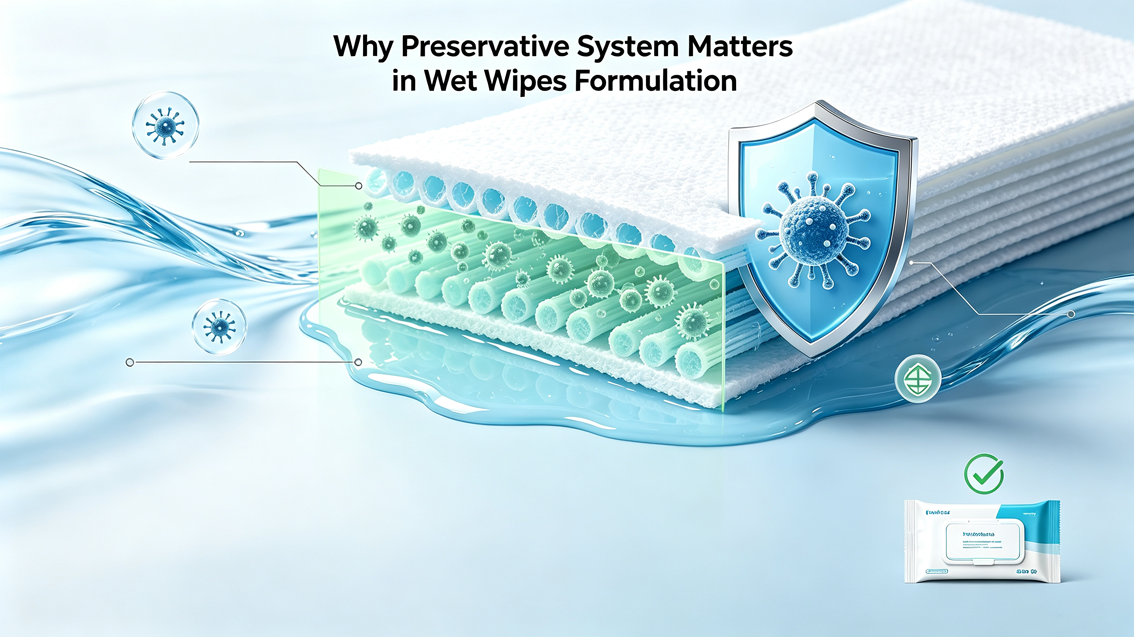
In the global wet wipes industry, manufacturers often focus on nonwoven fabric, packaging design, fragrance, and production efficiency. However, one of the most critical factors determining product safety, shelf life, and market acceptance is the preservative system of wet wipes liquid formulation.
Unlike dry products, wet wipes contain a high percentage of water, which creates an ideal environment for microbial growth. Without an effective preservation strategy, products may face problems such as:
Microbial contamination
Short shelf life
Odor changes
Product recalls
Failure in international regulatory testing
Choosing the right preservative system is therefore not only a technical decision but also a key factor affecting product positioning and market compliance.
1. What Is a Preservative System in Wet Wipes?
A preservative system is a combination of antimicrobial ingredients designed to control the growth of bacteria, yeast, and mold in wet wipes liquid.
A good preservation system should provide:
1. Broad-spectrum antimicrobial protection
Effective against:
Gram-positive bacteria
Gram-negative bacteria
Yeast
Mold
2. Formula compatibility
The preservative must work well with:
Surfactants
Humectants
Botanical extracts
Skin conditioners
Fragrances
3. Consumer safety and regulatory compliance
Different markets have different requirements for preservative ingredients, especially:
Baby wipes
Personal care wipes
Antibacterial wipes
Medical and disinfecting wipes
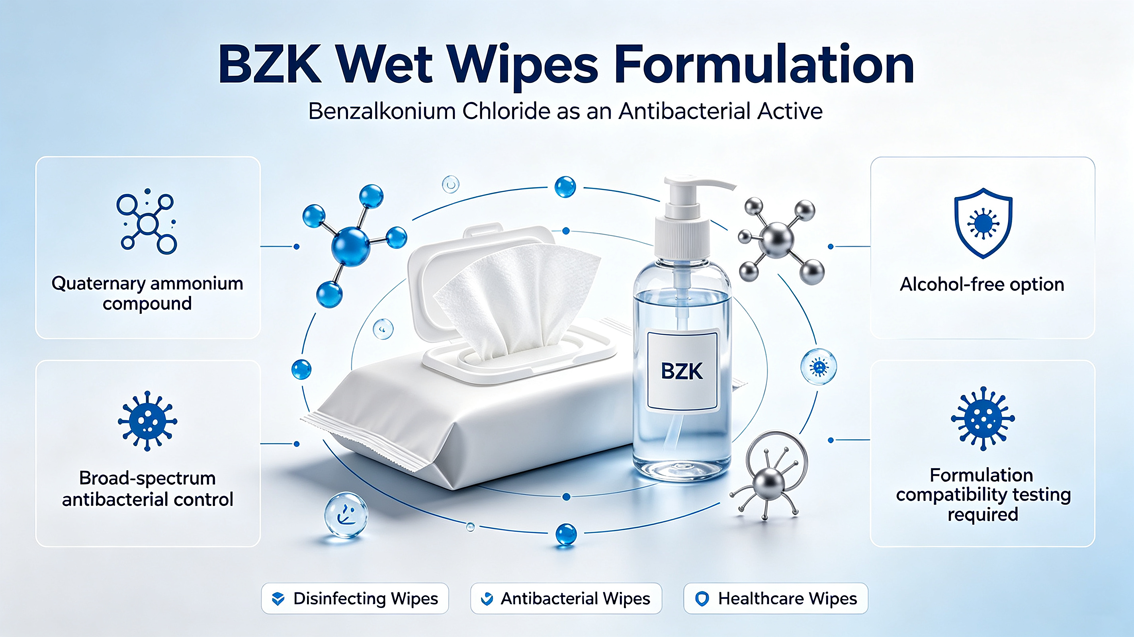
2. BZK (Benzalkonium Chloride) Wet Wipes Formulation
What is BZK?
Benzalkonium Chloride (BZK) is a quaternary ammonium compound widely used in antibacterial and disinfecting formulations.
It is one of the most commonly selected active ingredients for:
Antibacterial wipes
Surface disinfecting wipes
Healthcare wipes
Advantages of BZK
Strong antibacterial performance
BZK provides effective control against many bacteria and is widely recognized for antimicrobial applications.
Suitable for alcohol-free formulations
Compared with alcohol-based systems, BZK formulations can provide antimicrobial performance without the drying effect of high alcohol content.
Good market acceptance
BZK is commonly used in professional cleaning and healthcare applications.
Limitations of BZK
BZK performance can be affected by:
Anionic surfactants
High organic load
Incorrect concentration design
Therefore, formulation compatibility testing is essential.
Suitable Applications
Recommended for:
Disinfecting wipes
Antibacterial wipes
Medical cleaning wipes
High-performance hygiene products
3. CPC (Cetylpyridinium Chloride) Wet Wipes Formulation
What is CPC?
Cetylpyridinium Chloride (CPC) is another quaternary ammonium compound with antimicrobial properties.
It is widely used in:
Oral care products
Antimicrobial formulations
Personal hygiene applications
Advantages of CPC
Effective antimicrobial activity
CPC provides reliable antibacterial performance and can be used in hygiene-focused wet wipes.
Good formulation stability
When properly formulated, CPC shows good stability in water-based systems.
Consumer-friendly positioning
CPC is often associated with personal care and hygiene products.
Limitations of CPC
CPC may require careful formulation adjustment because:
Compatibility with surfactants needs evaluation
High levels may influence skin feel
Regulatory acceptance varies by region
Suitable Applications
Recommended for:
Personal hygiene wipes
Antibacterial cleansing wipes
Adult care wipes
Household hygiene wipes
4. PHMB Wet Wipes Formulation
What is PHMB?
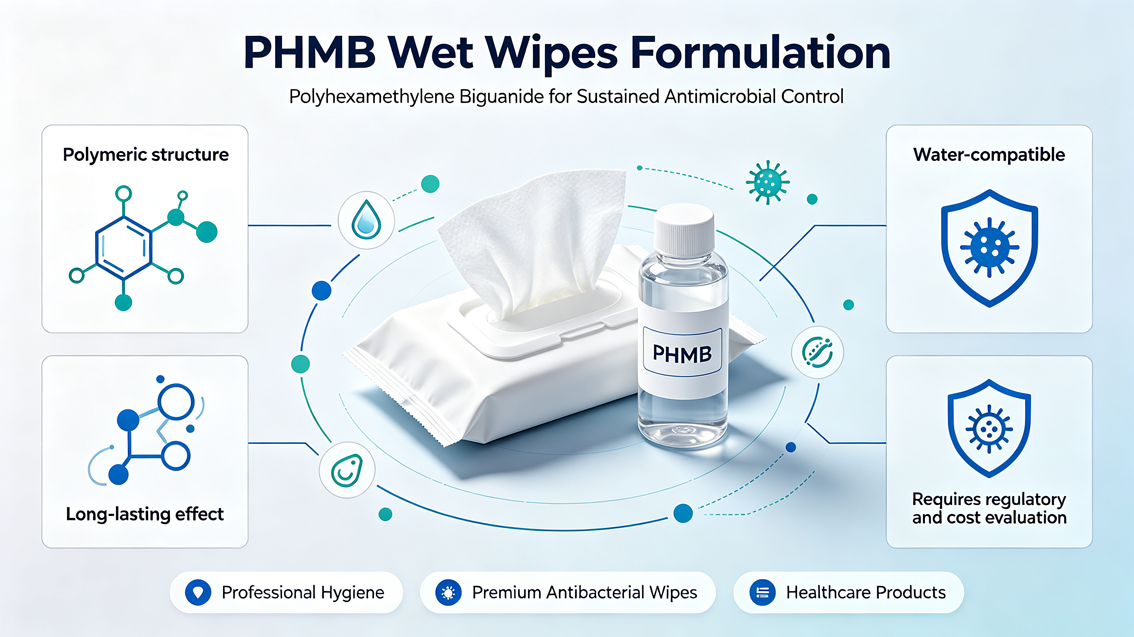
Polyhexamethylene Biguanide (PHMB) is a polymeric antimicrobial ingredient used in various hygiene and disinfecting applications.
Advantages of PHMB
Long-lasting antimicrobial effect
PHMB can provide sustained antimicrobial activity due to its polymer structure.
Good water compatibility
It performs well in water-based formulations.
Suitable for premium hygiene products
PHMB is often selected for products requiring enhanced antimicrobial positioning.
Limitations of PHMB
The main challenges include:
Regulatory restrictions in some regions
Higher formulation cost
Need for professional compatibility evaluation
Suitable Applications
Recommended for:
Professional hygiene wipes
High-end antibacterial wipes
Healthcare-related products
5. Preservative-Free Wet Wipes Solution
What Does "No Preservative" Mean?
Some manufacturers develop preservative-free wet wipes using alternative strategies, including:
Improved manufacturing hygiene
Sterile production environment
Optimized packaging
Low microbial raw materials
Controlled water quality
Advantages
Cleaner product concept
"Preservative-free" can appeal to consumers seeking minimalist formulations.
Suitable for sensitive skin positioning
Especially for:
Baby wipes
Sensitive skin wipes
Premium personal care wipes
Challenges
Preservative-free systems have higher requirements:
Manufacturing control
Factories need strict control of:
Raw material quality
Production environment
Filling process
Packaging design
Packaging must minimize contamination risk.
Higher production cost
More investment is usually required in quality control.
6. BZK vs CPC vs PHMB vs No Preservative Comparison
| System | Antimicrobial Ability | Cost Level | Application | Main Challenge |
| BZK | High | Medium | Disinfecting wipes, antibacterial wipes | Compatibility issues |
| CPC | Medium-High | Medium | Hygiene wipes, personal care wipes | Formula optimization |
| PHMB | High | Higher | Premium antibacterial products | Regulatory requirements |
| No Preservative | Depends on process | Higher | Baby wipes, sensitive wipes | Strict manufacturing control |
7. How Should Wet Wipes Manufacturers Choose?
There is no universal "best" preservative system.
The correct choice depends on:
1. Product Category
Different products require different protection levels.
Example:
Baby wipes → mild preservation system
Disinfecting wipes → stronger antimicrobial system
Medical wipes → strict compliance requirements
2. Target Market Regulations
Different countries have different requirements.
Before developing a formula, manufacturers should evaluate:
Allowed ingredients
Maximum usage levels
Required testing standards
3. Formula Composition
Preservative performance depends on:
pH value
Water quality
Botanical extracts
Surfactants
Fragrance system
A preservative that works well in one formula may fail in another.
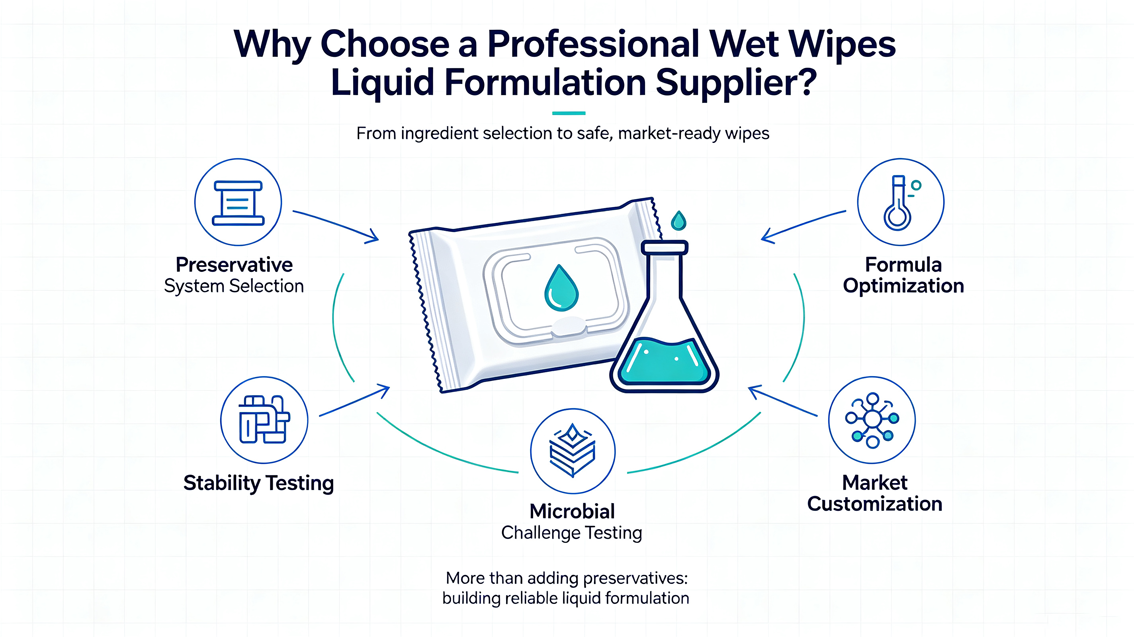
8. Why Choose Professional Wet Wipes Liquid Formulation Supplier?
Developing a successful wet wipes product requires more than selecting a preservative ingredient.
A professional formulation partner can help with:
Preservative system selection
Formula optimization
Stability testing
Microbial challenge testing support
Market-specific customization
For global wet wipes manufacturers, the goal is not simply adding preservatives, but creating a safe, stable, and market-ready wipes liquid formulation.
Conclusion
The choice between BZK, CPC, PHMB, and preservative-free solutions depends on product positioning, target market, regulatory requirements, and manufacturing capability.
A well-designed wet wipes liquid formulation should achieve the balance between:
Effective microbial protection
Consumer safety
Cost efficiency
Regulatory compliance
Choosing the right preservation system at the beginning of product development can significantly reduce quality risks and improve market competitiveness.