





 English
 USA
USA
 西班牙语
西班牙语
 俄罗斯
俄罗斯
 葡萄牙
葡萄牙
 印尼
印尼
 巴基斯坦
巴基斯坦
 尼日利亚
尼日利亚
 孟加拉
孟加拉
 墨西哥
墨西哥
 越南
越南
 日本
日本
 韩国
韩国
 沙特阿拉伯
沙特阿拉伯

Choosing the right baby wipes liquid is one of the most important decisions in the production of baby wipes. The liquid formulation directly affects the softness, skin feel, cleaning performance, preservation stability, product shelf life, and overall quality of finished baby wipes.
For baby wipes manufacturers and private label brands, selecting a suitable wipes liquid is not simply a matter of choosing a few ingredients. The formulation needs to match the target market, nonwoven fabric, packaging, manufacturing process, storage conditions, and regulatory requirements.
A well-designed baby wipes liquid formulation should provide effective cleaning while maintaining a mild and comfortable feel on sensitive skin. At the same time, it needs to remain stable during storage and provide adequate protection against microbial contamination.
So, how should manufacturers choose the right baby wipes liquid?
This guide explains the key factors to consider when selecting a baby wipes liquid for commercial production.
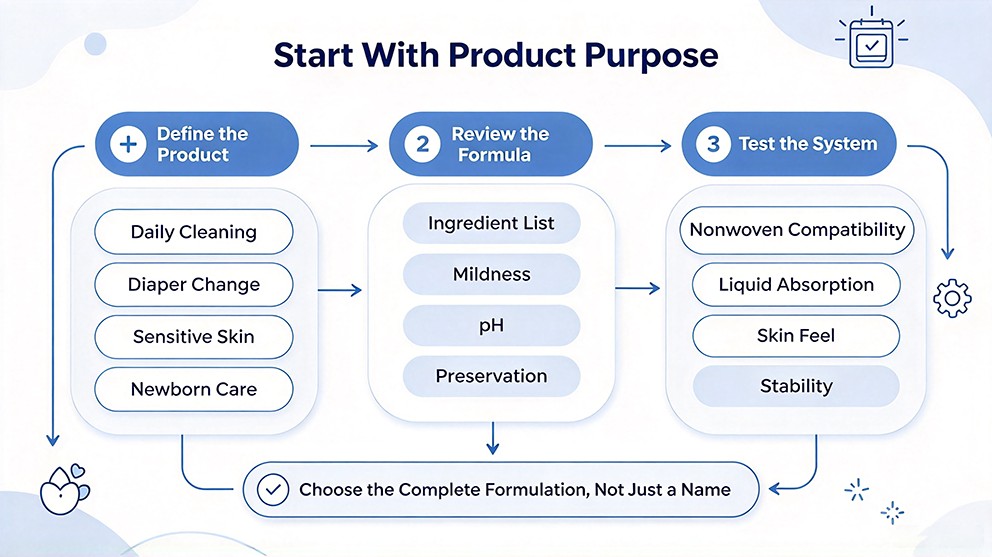
1. Understand the Purpose of the Baby Wipes Liquid
The first step is to determine what the finished baby wipes are expected to do.
Baby wipes are primarily designed for gentle cleaning of a baby's skin. Unlike household cleaning wipes or industrial wipes, baby wipes generally require a much milder formulation.
Depending on the product positioning, a baby wipes liquid may be designed for:
Daily baby skin cleaning
Diaper changes
Hand and face cleaning
Sensitive skin
Newborn care
Moisturizing baby wipes
Natural or plant-based baby wipes
Fragrance-free baby wipes
Premium baby wipes
Antimicrobial or hygienic applications where legally appropriate
The intended application determines which ingredients and formulation characteristics are appropriate.
For example, a formulation designed for newborn or sensitive-skin wipes may place greater emphasis on mildness and a minimal ingredient profile, while a general-purpose baby wipe may incorporate additional conditioning or botanical ingredients.
Therefore, before selecting a formulation, manufacturers should clearly define the target product.
2. Check the Ingredient List Carefully
The ingredient list is one of the most important factors when choosing a baby wipes liquid.
A typical baby wipes liquid may contain several functional categories of ingredients:
| Ingredient Category | Main Function |
| Purified Water | Main solvent |
| Humectants | Help maintain skin moisture |
| Mild Cleansing Agents | Assist with cleaning |
| Preservatives | Protect the formulation from microbial growth |
| Skin Conditioning Ingredients | Improve skin feel |
| Botanical Extracts | Product positioning and skin-conditioning benefits |
| pH Adjusters | Maintain appropriate formulation pH |
| Chelating Agents | Improve formulation stability |
| Fragrance | Provide scent, if required |
Not every baby wipes liquid needs every category.
In many cases, a simpler formulation can be advantageous, particularly when the product is intended for sensitive skin.
When comparing suppliers, manufacturers should request a complete ingredient list or formulation specification rather than evaluating the product only by its marketing name.
3. Choose a Mild Formulation
Mildness is one of the most important characteristics of baby wipes.
Baby skin can be more sensitive than adult skin, especially during frequent diaper changes. Therefore, the formulation should be designed with appropriate skin compatibility in mind.
A suitable baby wipes liquid should avoid unnecessary harsh ingredients and should be developed specifically for the intended application.
Manufacturers should pay particular attention to:
Surfactant selection
Preservative system
Fragrance level
Alcohol content
pH
Ingredient concentration
Skin-conditioning ingredients
A formulation that performs well in general cleaning wipes is not automatically suitable for baby wipes.
This is why manufacturers should work with a supplier that understands baby wipes liquid formulation rather than simply purchasing a general wet wipes solution.
4. Pay Attention to pH
pH is another important consideration when selecting baby wipes liquid.
A formulation that is too acidic or too alkaline may affect skin compatibility. For baby wipes, manufacturers generally look for a formulation with a skin-friendly pH range appropriate for the intended product.
However, there is no single pH value that is automatically correct for every baby wipes formulation.
The final pH depends on:
The complete formulation
Preservative system
Raw materials
Intended market
Product claims
Testing results
Applicable regulations
Therefore, manufacturers should not select a product simply because the supplier advertises a particular pH.
Instead, the formulation should be evaluated as a complete system.
5. Evaluate the Preservative System
Preservation is particularly important for wet wipes because they contain a large amount of water.
Water-based products can provide an environment where microorganisms may grow if the formulation is not adequately protected.
A suitable preservative system helps maintain product quality throughout its intended shelf life.
When choosing baby wipes liquid, manufacturers should ask suppliers:
What preservative system is used?
What is the concentration of each preservative?
Is the preservative suitable for the target market?
Has the formulation undergone microbiological testing?
Is preservative efficacy testing available?
What is the recommended shelf life?
Are there any restrictions in the destination market?
The preservative system should always be considered together with the entire formulation.
Simply increasing preservative concentration is not an appropriate solution for improving product safety. The formulation needs to be properly balanced and validated through appropriate testing.
6. Consider the Nonwoven Fabric
Many manufacturers focus heavily on the liquid formulation but overlook the relationship between the liquid and the nonwoven fabric.
This can create problems during production.
Baby wipes may use different types of nonwoven fabrics, including:
Spunlace nonwoven
Airlaid materials
Wetlaid materials
Plant-fiber nonwoven
Cotton-based materials
Bamboo fiber materials
Wood pulp blends
Synthetic fiber blends
Different fabrics can interact differently with the wipes liquid.
For example, the liquid may affect:
Liquid absorption
Liquid retention
Wet wipe softness
Liquid release during use
Folding performance
Packaging appearance
Long-term stability
Therefore, a formulation should ideally be tested with the actual nonwoven material used by the manufacturer.
7. Check Liquid Absorption and Retention
A good baby wipes liquid should distribute evenly throughout the wipe.
If the liquid is not absorbed properly, the finished product may have dry areas and overly wet areas.
If the liquid is too easily released, the packaging may become excessively wet.
If the liquid is retained too strongly by the nonwoven fabric, consumers may feel that the wipe is not wet enough during use.
Manufacturers should therefore evaluate:
Liquid absorption → Liquid distribution → Liquid retention → Liquid release
These characteristics can affect the consumer's experience significantly.
For commercial production, it is recommended to conduct actual production trials rather than evaluating the formulation only in a laboratory container.
8. Consider Skin Feel
The sensory characteristics of baby wipes are important for both parents and babies.
A high-quality baby wipe should generally feel:
Soft
Smooth
Moist
Comfortable
Non-sticky
Easy to wipe
Not excessively oily
Humectants and skin-conditioning ingredients can influence the final skin feel.
For example, ingredients such as Butylene Glycol may be used in certain formulations as humectants and solvents.
Botanical extracts such as chamomile may also be included in formulations positioned around gentle skin care.
However, adding more ingredients does not necessarily make a baby wipe better.
The goal should be to achieve the desired performance with a well-balanced formulation.
9. Fragrance or Fragrance-Free?
Manufacturers should decide whether the finished baby wipes will be scented or fragrance-free.
Fragrance-free baby wipes are commonly positioned toward consumers who prefer a simple formulation or products designed for sensitive skin.
Other brands may prefer a mild fragrance to create a recognizable product identity.
When selecting a baby wipes liquid, manufacturers should clearly communicate whether they need:
Fragrance-free formulation
Low-fragrance formulation
Specific fragrance
Natural fragrance positioning
Customized fragrance
If fragrance is used, manufacturers should also consider the regulatory requirements of the target market.
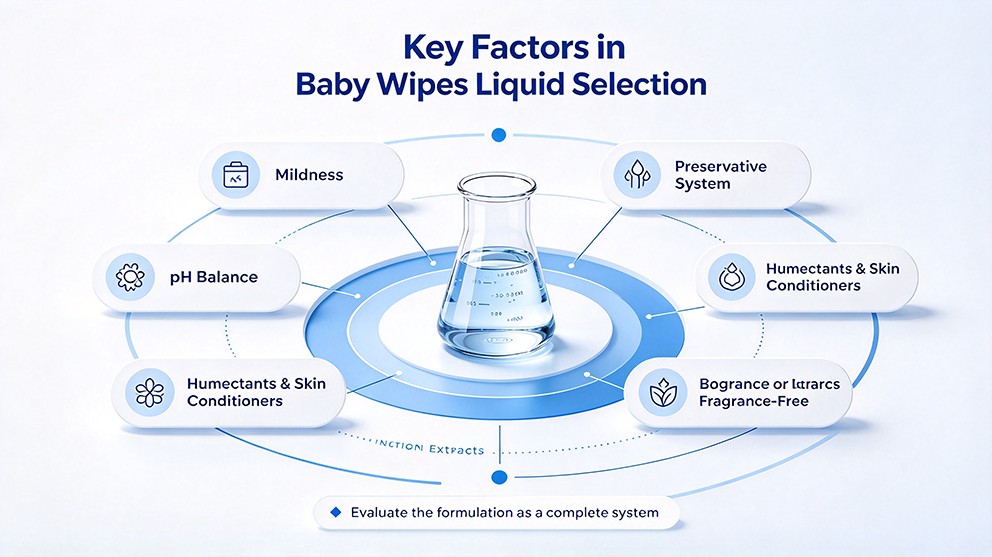
10. Consider Botanical Extracts
Botanical ingredients are increasingly used in baby wipes and personal care products.
Common examples include:
Chamomile Extract
Aloe Vera Extract
Calendula Extract
Green Tea Extract
Oat Extract
For example, Chamomilla Recutita Extract (Chamomile Extract) is commonly used in personal care formulations.
Botanical extracts can help support product positioning and may contribute to the overall skin-conditioning concept.
However, manufacturers should distinguish between:
formulation function and marketing claims.
Adding a botanical extract does not automatically mean that a product can make a specific therapeutic or medical claim.
Any product claim should be supported by appropriate evidence and comply with the regulations of the target market.
11. Check the Water Quality
Because water is usually the main component of baby wipes liquid, water quality is extremely important.
Manufacturers should pay attention to:
Purified water quality
Microbiological quality
Water treatment process
Storage conditions
Manufacturing hygiene
Poor water quality can negatively affect the stability and microbiological quality of the final product.
For professional wet wipes production, water treatment and manufacturing hygiene should therefore be considered part of the overall formulation system.
12. Evaluate Microbiological Stability
Wet wipes are high-water-content products, so microbiological control should be taken seriously.
Before commercial production, manufacturers should evaluate:
Total microbial count
Yeast and mold
Specified microorganisms
Preservative effectiveness
Stability during storage
Testing requirements vary depending on the target market and product classification.
A supplier should be able to provide relevant technical information and testing documentation where available.
For private label manufacturers, this is particularly important because the finished product may need to comply with the requirements of different countries.
13. Check Regulatory Requirements in the Target Market
One baby wipes liquid formulation may not be suitable for every market.
Regulations can vary between countries and regions.
For example, manufacturers exporting baby wipes should consider the requirements applicable to:
European markets
United States
United Kingdom
Middle East
Southeast Asia
Latin America
Africa
Other destination markets
Important considerations may include:
Ingredient restrictions
Preservative restrictions
Fragrance requirements
Labeling
Product claims
Safety documentation
Microbiological requirements
Registration or notification requirements where applicable
This is why it is important to tell the supplier where the finished baby wipes will be sold before requesting a formulation.
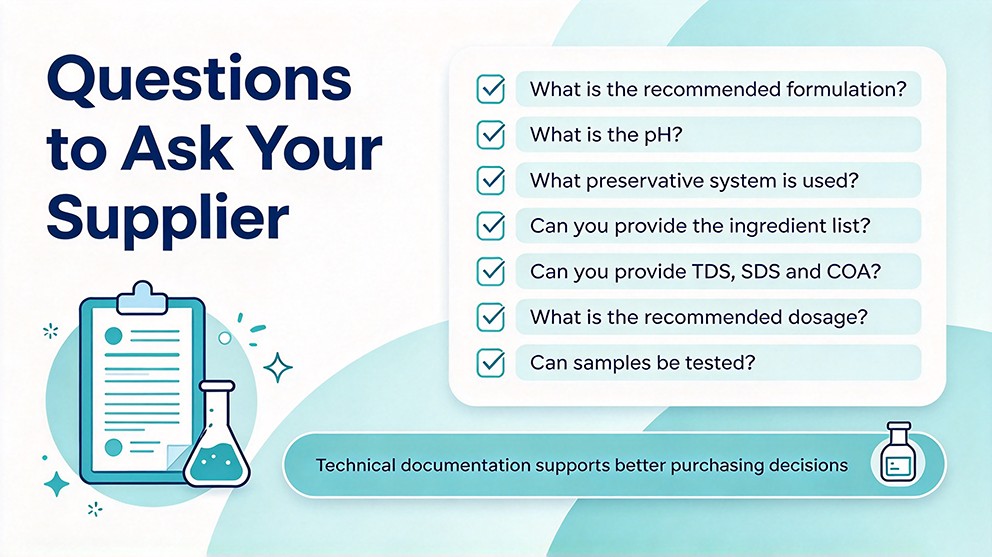
14. Ask the Supplier for Technical Documentation
A professional baby wipes liquid supplier should be able to provide technical documents for evaluation.
Depending on the product and market, manufacturers may request:
Technical Data Sheet (TDS)
Safety Data Sheet (SDS/MSDS), where applicable
Certificate of Analysis (COA)
Ingredient specification
Microbiological test results
Stability test information
Preservative efficacy information
Product specification
Recommended dosage
Storage conditions
Shelf-life information
These documents allow manufacturers to compare suppliers more objectively.
Instead of asking only:
"How much does the baby wipes liquid cost?"
manufacturers should also ask:
"What is the formulation, specification, recommended dosage, testing data and technical documentation?"
15. Determine the Recommended Liquid Add-On Ratio
The amount of liquid added to the nonwoven fabric can significantly affect the finished wipes.
For example, manufacturers may need to determine the appropriate ratio between:
Dry nonwoven weight : liquid weight
The optimal ratio depends on:
Fabric type
Fabric weight
Wipe dimensions
Folding method
Packaging type
Product positioning
Desired wetness
Liquid viscosity
Production equipment
The recommended ratio should therefore be confirmed through production testing.
A supplier should ideally provide a recommended dosage range rather than simply giving a single number without considering the customer's actual production conditions.
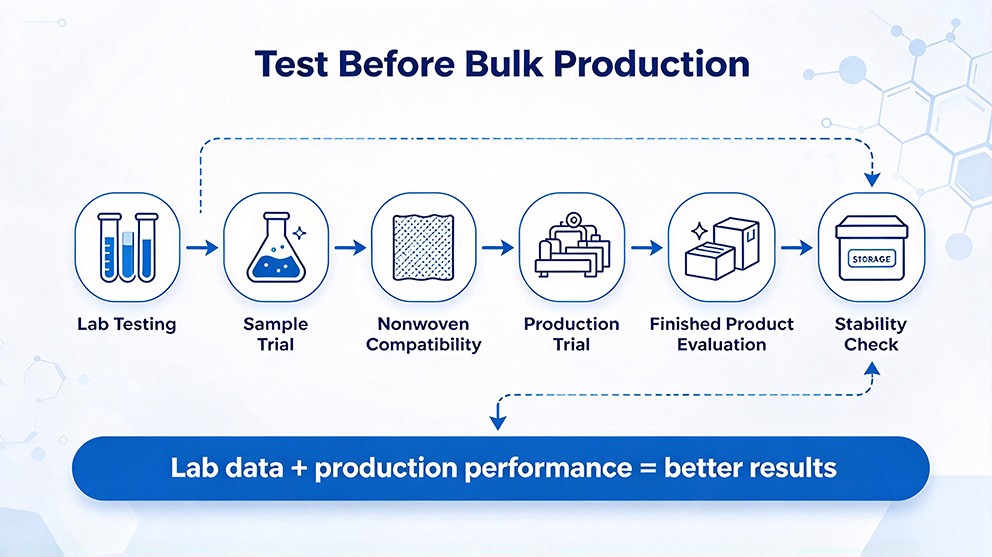
16. Test the Liquid With Your Actual Production Process
Laboratory testing is important, but production testing is equally important.
Before placing a large order, manufacturers should conduct a sample trial using their actual:
Nonwoven fabric
Production equipment
Folding method
Cutting process
Packaging film
Filling system
Storage conditions
During the trial, manufacturers can evaluate:
Appearance
Is the liquid clear, translucent or otherwise appropriate for the product?
Odor
Does the product have the expected odor?
Wetness
Does each wipe have sufficient and consistent moisture?
Skin Feel
Does the wipe feel soft and comfortable?
Packaging
Does the package remain clean without excessive liquid leakage?
Stability
Does the product remain stable during storage?
These tests can reveal issues that may not be visible during laboratory evaluation.
17. Compare Ready-Made and Customized Baby Wipes Liquid
Manufacturers generally have two options.
Ready-Made Baby Wipes Liquid
A ready-made formulation is suitable for manufacturers who want a relatively straightforward solution.
Advantages may include:
Faster product development
Easier purchasing
Lower development requirements
Existing technical data
Easier production trials
This option can be suitable for standard baby wipes products.
Customized Baby Wipes Liquid
Customized formulations are more suitable for brands with specific product requirements.
Customization may involve:
Preservative system
Botanical extracts
Humectants
Fragrance
pH
Skin feel
Cleaning performance
Ingredient restrictions
Target market requirements
For example, a manufacturer may request a formulation based on:
Aloe Vera + Vitamin E + Mild Preservative System
or:
Chamomile Extract + Humectant + Gentle Preservative System
The exact formulation should be developed according to the target application and regulatory requirements.
18. Consider the Cost of the Finished Wipe, Not Just the Liquid
Price per kilogram of baby wipes liquid is important, but it should not be the only consideration.
A cheaper formulation may have:
Different recommended dosage
Different raw material concentration
Different preservation requirements
Different production performance
Different stability
Different documentation
Therefore, manufacturers should calculate the actual liquid cost per finished wipe.
For example:
Liquid cost per wipe = Liquid cost per kg × liquid dosage per wipe
This gives a more meaningful comparison between suppliers.
A slightly more expensive liquid may not necessarily result in a significantly higher finished product cost if its dosage and performance are different.
19. Storage Conditions Are Important
Baby wipes liquid should be stored according to the supplier's recommended conditions.
Manufacturers should consider:
Storage temperature
Direct sunlight
Container sealing
Storage duration
Transportation conditions
Freeze/thaw exposure where relevant
If the liquid is transported internationally, manufacturers should also consider the shipping conditions and expected transit time.
Long transportation periods can expose the formulation to temperature fluctuations, which may affect product stability.
20. Choose a Supplier That Can Provide Technical Support
For professional wet wipes manufacturers, the supplier's technical support can be just as important as the formulation itself.
A reliable supplier should ideally be able to help with:
Formula selection
Sample testing
Dosage recommendations
Nonwoven compatibility
Production trials
Documentation
Regulatory information
Customized formulations
Troubleshooting
This is particularly important when developing new baby wipes products.
If the formulation does not perform correctly during production, simply changing suppliers may not solve the problem. The supplier needs to understand the relationship between the liquid, fabric and production process.
21. Common Mistakes When Choosing Baby Wipes Liquid
Manufacturers should avoid several common mistakes.
Mistake 1: Choosing Only Based on Price
The lowest price does not necessarily mean the lowest total production cost.
Mistake 2: Using a General Wet Wipes Formula for Baby Wipes
Different wipe applications require different formulation considerations.
Mistake 3: Ignoring the Preservative System
Water-based products require appropriate microbial control.
Mistake 4: Ignoring the Nonwoven Fabric
The same liquid can perform differently with different fabrics.
Mistake 5: Adding Too Many Ingredients
A longer ingredient list does not automatically mean a better product.
Mistake 6: Not Testing Before Bulk Purchase
Production trials can identify problems before a large commercial order is placed.
Mistake 7: Ignoring the Target Market
Ingredient and labeling requirements can vary between countries.
Mistake 8: Making Unsupported Claims
Ingredients such as aloe vera, chamomile or vitamin E can support product positioning, but product claims need to be appropriate and substantiated.
22. A Practical Checklist for Choosing Baby Wipes Liquid
Before selecting a supplier, manufacturers can use the following checklist:
| Item | What to Check |
| Application | Baby wipes / newborn wipes / sensitive skin |
| Formula | Ingredient list and concentration |
| pH | Suitable for intended application |
| Preservative | Appropriate preservation system |
| Fragrance | Fragrance-free or scented |
| Botanical Extract | Aloe Vera, Chamomile, etc. |
| Humectant | Skin-feel and moisture requirements |
| Nonwoven Compatibility | Tested with actual fabric |
| Dosage | Recommended liquid add-on ratio |
| Microbiology | Relevant test data |
| Stability | Storage and shelf-life information |
| Documentation | TDS, SDS, COA and other documents |
| Regulatory | Target-market requirements |
| Customization | Available if required |
| Technical Support | Sample and production assistance |
| MOQ | Minimum order quantity |
| Packaging | Suitable for transportation and storage |
23. Questions to Ask Your Baby Wipes Liquid Supplier
Before placing an order, manufacturers can ask the supplier the following questions:
1. What is the recommended formulation for baby wipes?
2. What is the recommended liquid dosage?
3. What is the pH of the formulation?
4. What preservative system is used?
5. Can you provide the complete ingredient information?
6. Is the formulation suitable for sensitive-skin baby wipes?
7. Can the formula be customized?
8. Can you provide a TDS and COA?
9. What microbiological testing has been performed?
10. What is the recommended storage condition and shelf life?
11. Can you provide samples for production testing?
12. Can you develop a formulation according to our target market?
The answers to these questions can help manufacturers evaluate suppliers before committing to a large purchase.
24. How We Develop Baby Wipes Liquid Formulations
At WipesLiquid, our focus is on developing and supplying liquid formulations for wet wipes manufacturers.
Instead of treating baby wipes liquid as a simple commodity, we consider the relationship between the formulation and the finished wet wipes.
Depending on the customer's requirements, a baby wipes liquid can be developed around different product concepts, such as:
Mild Baby Wipes Liquid
Sensitive Skin Baby Wipes Liquid
Baby Wipes Liquid with Aloe Vera Extract
Baby Wipes Liquid with Chamomile Extract
Baby Wipes Liquid with Vitamin E
Fragrance-Free Baby Wipes Liquid
Moisturizing Baby Wipes Liquid
Customized Baby Wipes Liquid
The final formulation can be adjusted according to the customer's target market, raw material requirements, nonwoven fabric, production process and product positioning.
For manufacturers looking for a specific formulation, sample testing and technical discussion are recommended before mass production.
25. Final Thoughts
Choosing the right baby wipes liquid requires more than comparing prices or looking at a list of popular ingredients.
Manufacturers should evaluate the complete formulation, including mildness, pH, preservation, microbiological stability, skin feel, nonwoven compatibility, liquid absorption, dosage, storage stability and regulatory requirements.
The most suitable formulation is the one that performs consistently under the manufacturer's actual production conditions and meets the requirements of the target market.
For this reason, manufacturers should request technical documentation, test samples with their actual nonwoven fabric, conduct production trials and confirm regulatory requirements before placing a bulk order.
A properly selected baby wipes liquid can help manufacturers achieve consistent product quality, improve consumer experience and build a reliable baby wipes product line.
Looking for a baby wipes liquid formulation for your production line?
Contact us to discuss your requirements, including your target market, nonwoven material, desired ingredients, packaging format and production process.
We can help you evaluate suitable baby wipes liquid formulations and develop customized solutions for your wet wipes manufacturing needs.