





 English
 USA
 西班牙语
 俄罗斯
 葡萄牙
 印尼
 巴基斯坦
 尼日利亚
 孟加拉
 墨西哥
 越南
 日本
 韩国
 沙特阿拉伯

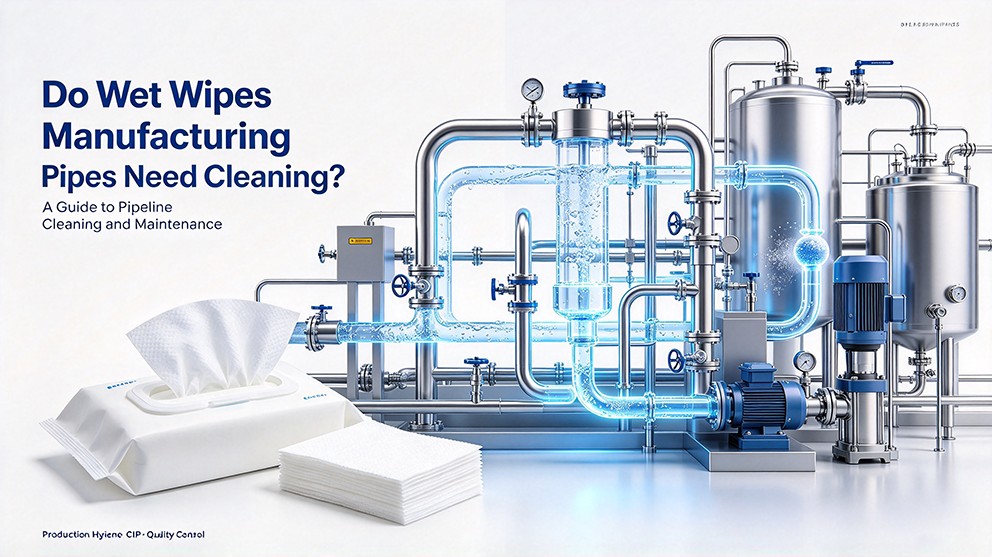
In wet wipes manufacturing, production pipelines are often used to transfer different types of liquid formulations, including baby wipes liquid, personal care wipes liquid, antibacterial wipes liquid, disinfecting wipes liquid, and household cleaning wipes liquid.
But do these pipelines need to be cleaned when manufacturers switch between different types of wet wipes?
The answer is yes. Regular and appropriate pipeline cleaning is an important part of production hygiene, product quality control, and equipment maintenance.
Different formulations may leave ingredient residues inside pipes, tanks, pumps, and valves. Without proper cleaning, these residues may affect subsequent batches, create compatibility problems, or increase microbial contamination risks.
This article explains why pipeline cleaning matters, when it should be performed, and how wet wipes manufacturers can establish an effective cleaning process.
1. Why Do Wet Wipes Manufacturing Pipelines Need Cleaning?
During production, wet wipes liquid passes through various components, including mixing tanks, transfer pipes, pumps, filters, valves, and filling systems.
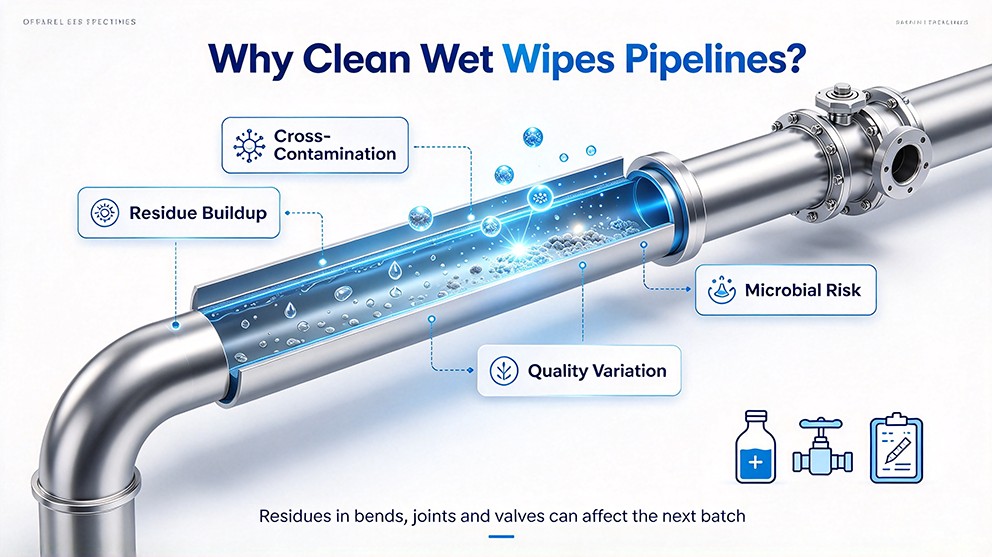
Even when the equipment appears clean, residual liquid may remain inside pipelines, especially at bends, joints, dead legs, and valve connections.
Several problems can occur if pipelines are not cleaned properly.
1. Cross-contamination between different formulations
Different wet wipes products may contain different surfactants, preservatives, fragrances, moisturizers, antibacterial ingredients, or other functional components.
When production changes from one formula to another, residual ingredients from the previous batch may enter the next product and affect its composition or performance.
2. Residual ingredient buildup
Some ingredients may accumulate on internal pipeline surfaces over time. Depending on the formulation, these residues may include surfactants, oils, fragrances, polymers, and other functional materials.
If they are not removed regularly, deposits may become increasingly difficult to clean.
3. Microbial contamination risks
Wet wipes liquids often contain a high proportion of water. Residual liquid and deposits inside pipelines may create conditions that support microbial growth if cleaning, drying, and sanitation are not properly controlled.
This is particularly important for baby wipes, personal care wipes, and other products requiring strict microbiological quality control.
4. Product quality and production stability
Residual materials can affect the appearance, odor, pH, and other characteristics of subsequent batches. Proper pipeline cleaning helps reduce these risks and maintain consistent production quality.
2. When Should Wet Wipes Manufacturers Clean Their Pipelines?
Pipeline cleaning frequency should be determined according to the production process, formulation characteristics, equipment design, and hygiene requirements.
The following situations generally require cleaning assessment:
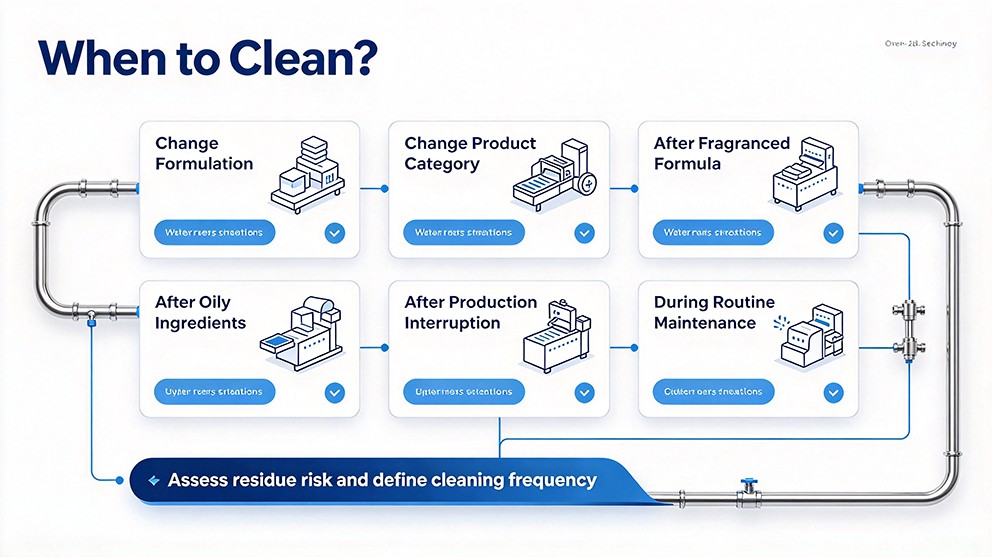
When changing product formulations: Especially when switching between products with significantly different ingredients or functions.
When changing functional product categories: For example, switching from baby wipes liquid to antibacterial or household cleaning wipes liquid.
After using strongly scented formulations: Fragrance residues may remain in pipelines and affect subsequent fragrance-free or differently scented products.
After processing oily or difficult-to-remove ingredients: Certain surfactants, oils, polymers, and other materials may require specific cleaning procedures.
After production interruptions: Extended shutdowns may require cleaning and additional hygiene checks before production resumes.
During routine maintenance: Regular cleaning should be included in the factory's equipment hygiene and maintenance program.
Not every product change requires the same cleaning procedure. Manufacturers should assess the risk of residue carryover and establish appropriate cleaning requirements for each production scenario.
3. How to Clean Wet Wipes Manufacturing Pipelines
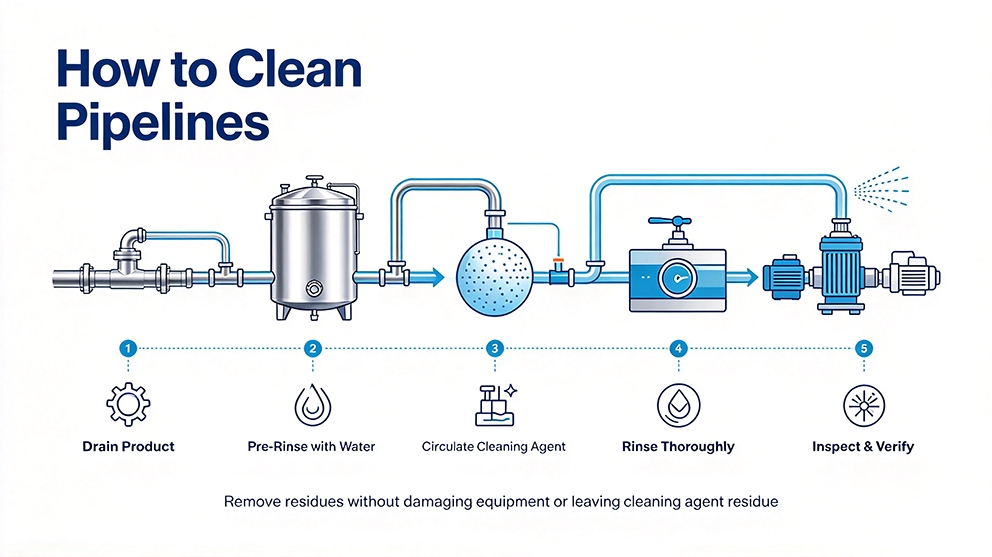
An effective pipeline cleaning process should remove product residues without damaging equipment or leaving unwanted cleaning agent residues.
A typical cleaning procedure may include the following steps.
Step 1: Drain the Remaining Product
Before cleaning, stop production and remove as much remaining liquid as possible from the mixing tank, pipelines, pumps, and associated equipment.
Recover usable product where appropriate and permitted by the factory's procedures.
Step 2: Pre-Rinse with Water
Flush the pipeline with suitable water to remove loose residues and reduce the amount of remaining formulation.
The water quality should meet the requirements of the manufacturing process.
Step 3: Circulate a Suitable Pipeline Cleaning Agent
For residues that cannot be removed effectively by water alone, use a suitable pipeline cleaning agent.
The cleaning agent should be selected according to the types of residues, equipment materials, and cleaning system.
During circulation, ensure that the cleaning solution reaches the relevant pipeline sections, valves, pumps, and other product-contact surfaces.
The concentration, temperature, circulation time, and flow conditions should follow the cleaning agent supplier's instructions and the factory's validated cleaning procedure.
Step 4: Rinse Thoroughly
After cleaning, flush the pipeline with suitable water to remove remaining cleaning agent and loosened residues.
Rinsing should continue until the established acceptance criteria are met. Depending on the process, these may include pH, conductivity, visual inspection, or other appropriate residue tests.
Step 5: Inspect and Verify Cleaning Results
Cleaning should not be judged by appearance alone.
Manufacturers should establish suitable verification methods, such as:
Visual inspection of accessible equipment surfaces
pH or conductivity testing of final rinse water
Residue testing where necessary
Microbiological monitoring according to the factory's hygiene program
The cleaning procedure should be documented, and production should resume only after the required acceptance criteria have been satisfied.
4. Why Is a Specialized Pipeline Cleaning Agent Important?
Water rinsing can remove some water-soluble residues, but it may not be sufficient for all wet wipes formulations.
Different ingredients have different cleaning characteristics. For example, surfactant residues, oily materials, fragrance components, and polymer-based ingredients may require different cleaning approaches.
A specialized pipeline cleaning agent can help improve residue removal and make the cleaning process more efficient when selected and used correctly.
When choosing a cleaning agent for wet wipes manufacturing, consider the following factors:
Cleaning performance: It should be suitable for the types of formulation residues found in the production system.
Equipment compatibility: It should be compatible with the pipeline materials, seals, pumps, and other equipment components.
Easy rinsing: It should be possible to remove cleaning agent residues effectively during the rinsing stage.
Application flexibility: It should suit the factory's cleaning method, such as manual cleaning or circulation cleaning.
Process safety: The product should have clear instructions for handling, dilution, application, and rinsing.
A cleaning agent should never be selected based only on its cleaning strength. Compatibility, residue removal, and process control are equally important.
5. Our Specialized Pipeline Cleaning Agent for Wet Wipes Manufacturers
To help wet wipes factories maintain cleaner production equipment and improve pipeline maintenance, our company provides a specialized pipeline cleaning agent designed for industrial cleaning applications in wet wipes manufacturing.
It can be considered as part of a pipeline cleaning program for production systems handling different wet wipes liquid formulations.
Potential application scenarios include:
Cleaning pipelines after baby wipes liquid production
Removing residues when switching between different personal care wipes formulations
Cleaning production systems used for household cleaning wipes liquids
Pipeline maintenance after processing surfactant-containing formulations
Routine cleaning of liquid transfer systems and related production equipment
The appropriate application method, dilution ratio, cleaning time, and operating conditions should be confirmed according to the product's technical instructions and the factory's equipment requirements.
For manufacturers handling multiple wet wipes formulations, using a suitable dedicated cleaning agent can help establish a more standardized pipeline cleaning procedure.
6. How to Establish a Better Pipeline Cleaning Management System
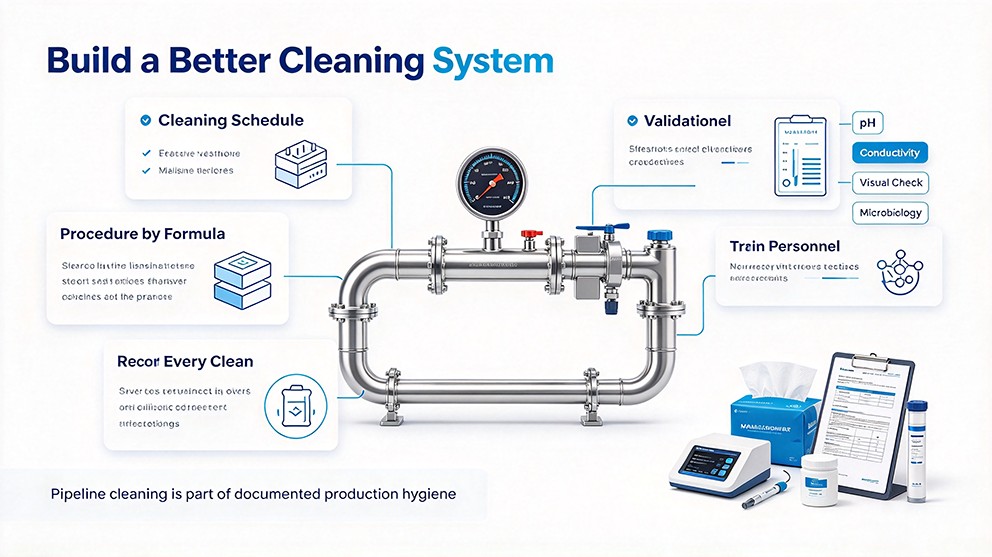
For wet wipes factories producing multiple product categories, pipeline cleaning should be part of a documented production hygiene management system.
We recommend establishing the following practices:
1. Create a cleaning schedule
Define cleaning frequency according to production categories, formulation differences, and contamination risks.
2. Establish cleaning procedures for different formulations
A fragrance-containing formula, an oily cleaning formulation, and a water-based baby wipes formula may require different cleaning considerations.
3. Record every cleaning operation
Document the cleaning date, previous product, next product, cleaning agent used, operating conditions, and inspection results.
4. Verify cleaning effectiveness
Use appropriate inspection and testing methods rather than relying only on visual judgment.
5. Train production personnel
Ensure that operators understand cleaning procedures, chemical handling requirements, equipment compatibility, and rinsing criteria.
A well-managed cleaning system helps reduce cross-contamination risks and supports more consistent wet wipes production.
Conclusion
Pipeline cleaning is an important part of wet wipes manufacturing, especially for factories producing different functional wipes using shared production equipment.
Residual formulations may cause cross-contamination, ingredient buildup, and microbial control challenges. Establishing appropriate cleaning procedures, selecting a compatible pipeline cleaning agent, and verifying cleaning effectiveness can help manufacturers maintain production hygiene and product quality.
Looking for a specialized pipeline cleaning agent for your wet wipes factory?
We provide pipeline cleaning solutions for wet wipes manufacturers. Contact our team to discuss your production process, formulation types, equipment materials, and cleaning requirements. We can help you evaluate a suitable cleaning solution for your production system.