





 English
 USA
USA
 西班牙语
西班牙语
 俄罗斯
俄罗斯
 葡萄牙
葡萄牙
 印尼
印尼
 巴基斯坦
巴基斯坦
 尼日利亚
尼日利亚
 孟加拉
孟加拉
 墨西哥
墨西哥
 越南
越南
 日本
日本
 韩国
韩国
 沙特阿拉伯
沙特阿拉伯

Fragrance is an important consideration when developing wet wipes. Some consumers prefer wipes with a fresh, pleasant scent, while others choose fragrance-free products, especially for sensitive skin or baby care.
For wet wipes manufacturers, private label brands, and personal care product developers, deciding whether to add fragrance is more than a marketing decision. Fragrance can affect the formulation, ingredient compatibility, product stability, preservation system, packaging, and overall user experience.
A well-designed fragranced wet wipe should deliver a pleasant scent without compromising cleaning performance, formulation stability, or the intended product quality. At the same time, a fragrance-free formulation can be an attractive option for products designed around simplicity and sensitive-skin positioning.
So, should wet wipes contain fragrance? How does fragrance interact with wet wipes liquid? And what should manufacturers consider when selecting a fragranced or fragrance-free formulation?
This guide explains the key factors wet wipes manufacturers should understand before making a decision.
1. Why Do Wet Wipes Manufacturers Consider Adding Fragrance?
Fragrance can play several roles in a wet wipes product.
First, it can improve the sensory experience. A fresh, clean scent may make a product more appealing to consumers and help establish a recognizable brand identity.
Second, fragrance can support product differentiation. For example, baby wipes, facial wipes, personal cleansing wipes, household cleaning wipes, and pet wipes may have different fragrance preferences.
Third, fragrance can influence how consumers perceive a product. A mild floral scent, a fresh citrus note, or a clean cotton fragrance can help communicate a particular product concept.
However, fragrance is not essential for every wet wipes formulation.
The decision should depend on the intended application, target customers, market positioning, and formulation requirements.
For wet wipes manufacturers, the most important question is not simply whether fragrance should be added, but whether fragrance will provide a meaningful benefit to the finished product.
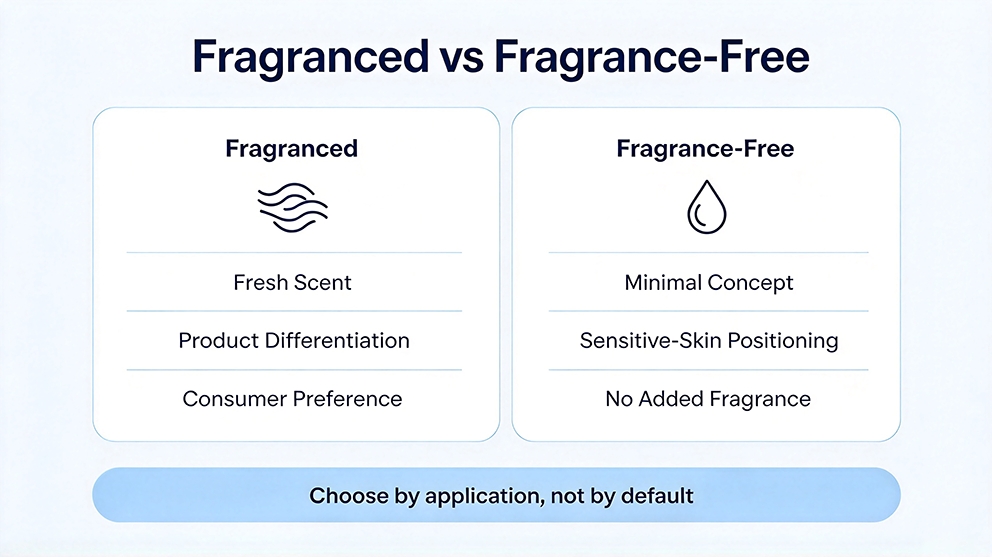
2. Fragranced Wet Wipes vs. Fragrance-Free Wet Wipes
Before selecting a wet wipes liquid, manufacturers should understand the differences between fragranced and fragrance-free products.
Fragranced Wet Wipes
Fragranced wet wipes are designed to provide a noticeable or subtle scent during use.
Potential advantages include:
A more distinctive sensory experience
Greater flexibility in product positioning
Opportunities for fragrance-based product differentiation
A pleasant scent during cleaning
Support for a recognizable brand identity
Fragranced formulations may be suitable for household cleaning wipes, general-purpose cleaning wipes, selected personal care wipes, and other products where fragrance is part of the intended user experience.
However, manufacturers need to consider fragrance compatibility, potential irritation or sensitization, stability, and labeling requirements.
Fragrance-Free Wet Wipes
Fragrance-free wet wipes are formulated without added fragrance ingredients.
Potential advantages include:
A simpler formulation concept
No added fragrance odor
Suitability for consumers who prefer fragrance-free products
Greater flexibility for certain sensitive-skin product concepts
Avoidance of fragrance-related compatibility issues
Fragrance-free formulations are often considered for baby wipes, facial wipes, intimate care wipes, and selected personal care applications.
However, fragrance-free does not automatically mean hypoallergenic, non-irritating, or suitable for every sensitive-skin user. These claims require appropriate support.
Manufacturers should also distinguish between fragrance-free and unscented. Depending on the market and product formulation, an unscented product may contain ingredients intended to mask other odors, whereas fragrance-free generally indicates that fragrance has not been added for scent or masking purposes.
The exact terminology and labeling should be reviewed for the intended market.
3. Which Types of Wet Wipes May Benefit from Fragrance?
Different wet wipes applications require different fragrance strategies.
Baby Wipes
Baby wipes are frequently developed with mildness and skin compatibility as priorities.
Many brands choose fragrance-free formulations to avoid unnecessary fragrance exposure. Other brands offer lightly fragranced versions to meet particular consumer preferences.
When developing baby wipes, manufacturers should evaluate the complete formulation rather than assuming that a low fragrance concentration automatically makes a product suitable for sensitive skin.
Facial and Makeup Remover Wipes
Facial wipes are used on the face, where consumers may be particularly sensitive to fragrance and other ingredients.
Fragrance-free formulations can be attractive for these applications. If fragrance is included, the finished product should be evaluated for skin compatibility and intended use.
Personal Cleansing Wipes
Personal cleansing wipes may be offered in fragranced and fragrance-free versions.
The choice depends on the intended application, consumer preferences, and applicable regulatory requirements.
For products intended for intimate areas, manufacturers should pay particular attention to the product's intended use and the potential for irritation or sensitization.
Household Cleaning Wipes
Fragrance can be an important feature of household cleaning wipes.
Citrus, floral, herbal, and fresh-linen scent profiles are often considered during product development.
In these applications, fragrance may contribute significantly to the overall cleaning experience. However, it should not be used to imply that a product has stronger cleaning or disinfecting performance unless the relevant claims are substantiated.
Floor and Surface Cleaning Wipes
For floor and surface cleaning wipes, fragrance can help differentiate products and influence the perception of freshness after cleaning.
The formulation should be tested to ensure that the fragrance does not cause undesirable residue, streaking, or compatibility problems with the intended surfaces.
Pet Wipes
Pet wipes require a formulation specifically designed for their intended use.
Manufacturers should not assume that fragrances suitable for human personal care products are automatically suitable for animals. Fragrance selection, exposure, potential ingestion through grooming, and applicable product requirements should be considered carefully.
4. What Is the Relationship Between Fragrance and Wet Wipes Liquid?
This is one of the most important technical questions for wet wipes liquid suppliers and manufacturers.
Fragrance is not simply an ingredient that can be added to any liquid formulation without evaluation.
A typical water-based wet wipes liquid may contain:
Purified water
Humectants
Surfactants
Preservatives
Chelating agents
pH adjusters
Skin-conditioning ingredients
Botanical extracts
Fragrance, where required
Solubilizers or other supporting ingredients, where necessary
Fragrance is generally a mixture of aromatic substances. Depending on its composition, it may contain ingredients with different solubility, volatility, and compatibility characteristics.
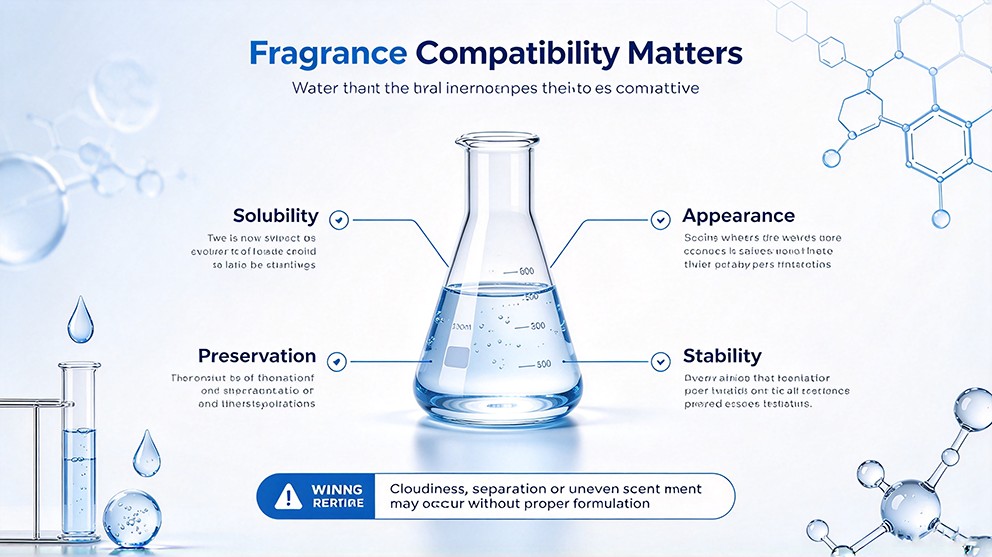
Many fragrance materials have limited water solubility. Therefore, adding fragrance directly to a water-based wet wipes liquid may result in cloudiness, separation, floating droplets, or uneven distribution.
The outcome depends on the fragrance composition and the complete formulation.
This is why fragrance selection should be part of the formulation development process rather than an afterthought.
A fragrance that works well in one wet wipes liquid may not work equally well in another.
5. Why Does Fragrance Solubility Matter?
Most conventional wet wipes liquids are water-based systems.
When a fragrance is not sufficiently compatible with the aqueous formulation, several problems may occur:
The liquid becomes cloudy.
Fragrance droplets appear on the surface.
The fragrance separates during storage.
The scent is distributed unevenly across the wipes.
The fragrance concentration varies between different parts of the package.
The product develops an undesirable appearance.
These issues can affect both product quality and consumer confidence.
To address them, formulators may evaluate suitable fragrance materials, solubilizers, surfactants, and other formulation adjustments.
The appropriate solution depends on the fragrance and the rest of the formulation. There is no universal solubilizer or dosage that works for every wet wipes liquid.
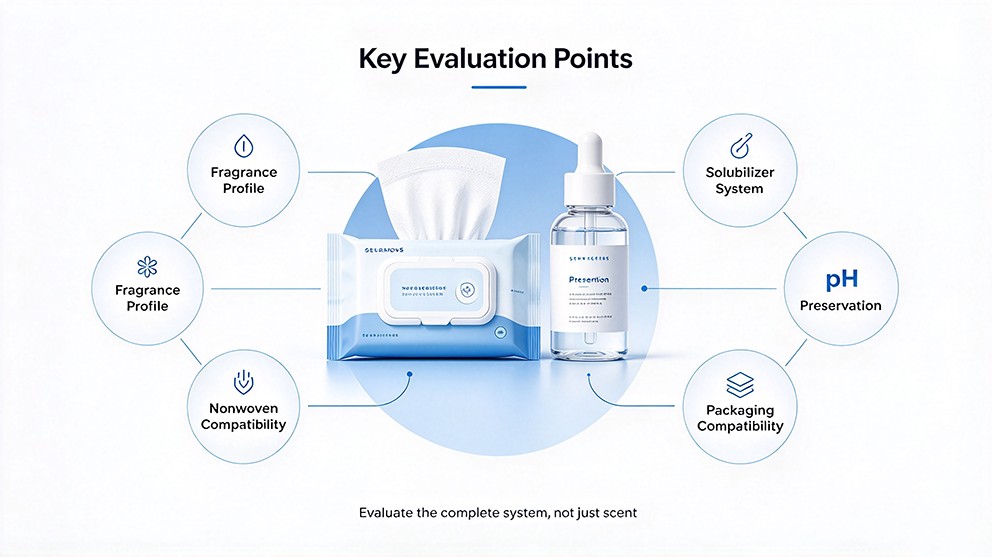
For manufacturers, the practical lesson is simple: always evaluate fragrance compatibility in the complete wet wipes formulation.
6. What Is a Fragrance Solubilizer?
A fragrance solubilizer is an ingredient used to help incorporate fragrance into a water-based formulation.
Depending on the formulation, suitable nonionic solubilizers or other compatible ingredients may be considered.
Their function is to improve fragrance incorporation and help maintain a more uniform liquid.
However, a solubilizer should not be selected solely because it can make a fragrance appear clear.
Manufacturers also need to evaluate:
Compatibility with the fragrance
Compatibility with other ingredients
Required concentration
Foaming characteristics
Skin compatibility, where relevant
Effect on the finished product's appearance
Long-term stability
Cost and regulatory requirements
Adding too much solubilizer may change the formulation's sensory properties or other performance characteristics.
The goal is to use an appropriate formulation system that provides acceptable fragrance distribution without creating unnecessary formulation complexity.
7. Does Adding Fragrance Affect the Preservative System?
This is an important consideration for water-based wet wipes liquids.
The addition of fragrance may change the composition of the formulation. Depending on the fragrance and the other ingredients, it may influence the solubility, partitioning, or availability of certain components.
Some fragrance materials may also interact with other formulation ingredients.
However, it would be inaccurate to assume that all fragrances weaken preservatives or that fragrance automatically creates a microbiological problem.
The effect depends on the complete formulation.
For this reason, manufacturers should evaluate the preservation performance of the finished formulation, particularly when a fragrance is added to an established fragrance-free product.
Relevant evaluations may include:
Microbiological quality testing
Preservative efficacy testing, where appropriate
Stability testing
Compatibility testing
Finished-wipe testing
Testing should be selected according to the product type, intended use, and applicable requirements.
It is also important to distinguish between testing the bulk wet wipes liquid and testing the finished wet wipes. The nonwoven substrate, packaging, and manufacturing process can influence the microbiological quality of the final product.
Adding fragrance should never be treated as a substitute for an appropriate preservation system.
8. Can Fragrance Affect the pH of Wet Wipes Liquid?
Fragrance does not necessarily cause a significant pH change.
The effect depends on the fragrance composition, concentration, and the other ingredients in the formulation.
Nevertheless, manufacturers should measure the pH after incorporating fragrance and completing any necessary formulation adjustments.
This is particularly important for personal care products where pH is a relevant formulation parameter.
If pH adjustment is required, the selected pH adjuster should be compatible with the complete formulation.
The final product should then be evaluated for stability and performance.
Manufacturers should avoid assuming that a formulation retains exactly the same properties after adding a new ingredient.
9. Does Fragrance Affect Wet Wipes Stability?
Yes, fragrance can influence formulation stability, although the extent varies by product.
Fragrance materials may contain volatile components that change over time. Some may also be sensitive to light, oxygen, heat, or interactions with other ingredients.
Potential problems include:
Changes in fragrance intensity
Changes in fragrance character
Discoloration
Cloudiness
Separation
Changes in odor during storage
Interaction with packaging materials
A fragrance that smells pleasant immediately after manufacturing may not maintain the same scent profile throughout the intended shelf life.
Therefore, stability testing should evaluate both the liquid and the finished wipes.
Manufacturers should consider:
Initial appearance → Initial fragrance → Storage stability → Fragrance retention → Packaging compatibility → Finished-product quality
Testing should reflect the product's intended storage conditions and shelf life.
10. How Does Fragrance Interact With Nonwoven Fabric?
The wet wipes liquid is absorbed into a nonwoven substrate, so fragrance performance cannot be evaluated using the liquid alone.
Different nonwoven materials may absorb, retain, or release fragrance components differently.
Factors that can influence fragrance performance include:
Fiber composition
Fabric structure
Basis weight
Liquid add-on ratio
Packaging
Fragrance volatility
Storage temperature
Storage duration
For example, a fragrance may smell stronger when the package is first opened but become less noticeable after prolonged storage.
Some fragrance components may also interact with the substrate or packaging materials.
Therefore, fragrance evaluation should be performed using the actual nonwoven fabric and packaging intended for commercial production.
11. Can Fragrance Affect the Packaging?
Packaging is another important part of fragranced wet wipes development.
Wet wipes packaging needs to retain moisture while protecting the product during storage and transportation.
At the same time, some fragrance components may interact with packaging materials or permeate through them over time.
Potential consequences include:
Loss of fragrance intensity
Changes in the fragrance profile
Odor transfer
Packaging compatibility problems
Changes in the perceived quality of the product
The extent of these effects depends on the fragrance composition, packaging structure, and storage conditions.
For this reason, manufacturers should conduct packaging compatibility testing using the final formulation and actual packaging materials.
This is particularly important for products with a long shelf life or a strong fragrance positioning.
12. How Much Fragrance Should Be Added to Wet Wipes Liquid?
There is no single fragrance concentration that is suitable for all wet wipes.
The appropriate amount depends on:
The fragrance composition
Fragrance strength
Product application
Intended scent intensity
Total formulation composition
Nonwoven substrate
Packaging
Regulatory restrictions
Supplier recommendations
A fragrance designed to provide a noticeable scent at a low concentration may not require the same dosage as a different fragrance.
Similarly, the concentration suitable for a household cleaning wipe may not be appropriate for baby wipes or facial wipes.
Manufacturers should follow the fragrance supplier's recommended use level and applicable restrictions.
The final concentration should be optimized through formulation trials and finished-product evaluation.
It is not advisable to increase fragrance concentration simply because the scent becomes less noticeable after storage. The cause of the fragrance change should first be investigated.
13. How to Choose the Right Fragrance for Wet Wipes
Fragrance selection should begin with the intended product and target consumer.
Fresh and Clean Fragrances
Fresh scent profiles can be considered for household cleaning wipes, general-purpose wipes, and selected personal care products.
Citrus Fragrances
Citrus profiles may suit cleaning wipes and products positioned around freshness.
However, the complete fragrance composition should be assessed for stability, compatibility, and applicable restrictions.
Floral Fragrances
Floral profiles can support a softer or more premium product concept.
Their suitability depends on the intended application and target market.
Herbal Fragrances
Herbal profiles may be considered for products positioned around a natural or botanical concept.
A herbal fragrance should not automatically be described as natural unless the ingredients and relevant claims support that description.
Fragrance-Free Formulations
Fragrance-free formulations are worth considering when the brand prioritizes a minimal ingredient profile or when fragrance is not necessary for the product's intended function.
The best choice is the one that supports the product's positioning without creating unnecessary formulation or compliance challenges.
14. Natural Fragrance vs. Synthetic Fragrance
Some manufacturers prefer natural fragrance materials, while others choose conventional fragrance compositions.
Neither category is automatically superior in every application.
Natural fragrance materials may offer a particular marketing appeal, but their composition can vary depending on the source and processing method.
They may also present challenges involving oxidation, odor consistency, solubility, or stability.
Synthetic fragrance compositions can offer greater flexibility in scent design and consistency, but they still require appropriate safety assessment and compliance with applicable restrictions.
Manufacturers should evaluate each fragrance based on:
Composition and documentation
Intended use
Stability
Solubility
Skin compatibility, where relevant
Applicable fragrance restrictions
Labeling requirements
Cost
The terms natural, plant-derived, and synthetic should be used accurately and should not be treated as automatic indicators of safety.
15. Fragrance and Sensitive-Skin Products
Fragrance can be a source of irritation or allergic contact sensitization for some individuals.
This does not mean that every fragranced product causes irritation. However, fragrance exposure should be considered when developing products intended for frequent use or sensitive skin.
For baby wipes, facial wipes, intimate care wipes, and other personal care applications, manufacturers should carefully assess whether fragrance is necessary.
If fragrance is included, the formulation should be evaluated for the intended use and relevant safety requirements.
Manufacturers should also avoid assuming that a low fragrance concentration guarantees that the finished product is non-irritating.
Similarly, fragrance-free products are not automatically hypoallergenic.
Claims such as "dermatologically tested," "hypoallergenic," or "suitable for sensitive skin" should be supported by appropriate evidence.
16. Fragrance Allergens and Labeling Requirements
Fragrance ingredients may be subject to specific labeling and restriction requirements depending on the destination market and product classification.
For example, the European Union has specific requirements concerning the labeling of certain fragrance allergens in cosmetic products. The applicable requirements depend on the ingredients, concentration, product category, and relevant legislation.
Requirements for cosmetic wet wipes may differ from those applicable to household cleaning products or other product categories.
Before launching a fragranced wet wipe, manufacturers should review:
Fragrance ingredient documentation
Safety Data Sheet, where applicable
Applicable fragrance allergen information
Relevant IFRA documentation and restrictions
Destination-market ingredient restrictions
Product labeling requirements
Product-specific safety assessment requirements
IFRA standards are relevant to the safe use of fragrance materials within their scope, but IFRA documentation does not replace all applicable legal or product-specific requirements.
For export-oriented wet wipes manufacturers, the target market should be defined before the fragrance is selected.
17. Fragrance in the Wet Wipes Liquid Manufacturing Process
Fragrance incorporation should be managed as part of the production process.
The appropriate method depends on the formulation and the physical characteristics of the fragrance.
A typical development workflow may include:
Confirming the fragrance specification.
Reviewing the fragrance supplier's recommended use level.
Evaluating solubility and compatibility.
Selecting a suitable incorporation method.
Checking the formulation's appearance and odor.
Measuring the final pH where relevant.
Conducting stability testing.
Testing the formulation with the intended nonwoven.
Evaluating the finished wipes in the final packaging.
Confirming the product's quality specifications before mass production.
Manufacturers should follow the validated manufacturing procedure and supplier guidance rather than assume that every fragrance can be added at the same stage of production.
Where necessary, a small-scale trial should be conducted before changing the production formula.
18. Common Problems When Adding Fragrance to Wet Wipes Liquid
Problem 1: The Liquid Becomes Cloudy
Possible causes include insufficient fragrance solubilization, incompatibility, or changes in the formulation.
Recommended approach: Evaluate the fragrance composition, solubilizer system, and overall compatibility.
Problem 2: Fragrance Separates During Storage
Possible causes include an unsuitable solubilizer system, formulation instability, or changes under storage conditions.
Recommended approach: Conduct compatibility and stability trials before production.
Problem 3: The Fragrance Smells Different After Storage
Possible causes include volatility, oxidation, interaction with packaging, or other formulation changes.
Recommended approach: Evaluate the fragrance and packaging together under appropriate storage conditions.
Problem 4: The Scent Is Too Strong
Possible causes include excessive dosage or a fragrance composition that is too intense for the intended application.
Recommended approach: Review the fragrance specification and optimize the dosage through testing.
Problem 5: The Fragrance Is Too Weak
Possible causes include fragrance volatility, packaging permeability, substrate interactions, or an unsuitable fragrance profile.
Recommended approach: Investigate fragrance retention and packaging compatibility before increasing the concentration.
Problem 6: The Formulation Changes After Fragrance Is Added
Possible causes include interactions with surfactants, preservatives, botanical extracts, or other ingredients.
Recommended approach: Reevaluate the complete formulation rather than treating fragrance as an isolated ingredient.
19. Should Wet Wipes Manufacturers Offer Both Fragranced and Fragrance-Free Products?
For some brands, offering both options can be a useful product-development strategy.
For example, a manufacturer may develop:
Fragranced baby wipes
Fragrance-free baby wipes
Fresh-scent household cleaning wipes
Citrus-scent cleaning wipes
Fragrance-free facial wipes
Fragranced personal cleansing wipes
This approach allows a brand to serve different consumer preferences without forcing every product into the same formulation concept.
However, each version should be evaluated independently.
A fragrance-free version and a fragranced version may differ in ingredient composition, stability, sensory properties, and preservation performance. Any relevant differences should be assessed during product development.
20. How Fragrance Affects the Cost of Wet Wipes Liquid
Fragrance can influence the overall formulation cost.
The cost impact depends on the fragrance specification, dosage, solubilizer requirements, and other formulation adjustments.
When comparing two wet wipes liquids, manufacturers should consider more than the price per kilogram.
Important factors include:
Fragrance cost
Recommended fragrance concentration
Solubilizer requirements
Manufacturing complexity
Stability requirements
Packaging compatibility
Testing costs
Finished-product performance
A more expensive fragrance is not automatically better, and a cheaper fragrance is not necessarily more cost-effective if it requires a higher dosage or creates stability problems.
The goal should be to achieve the desired scent profile and product quality at a commercially appropriate cost.
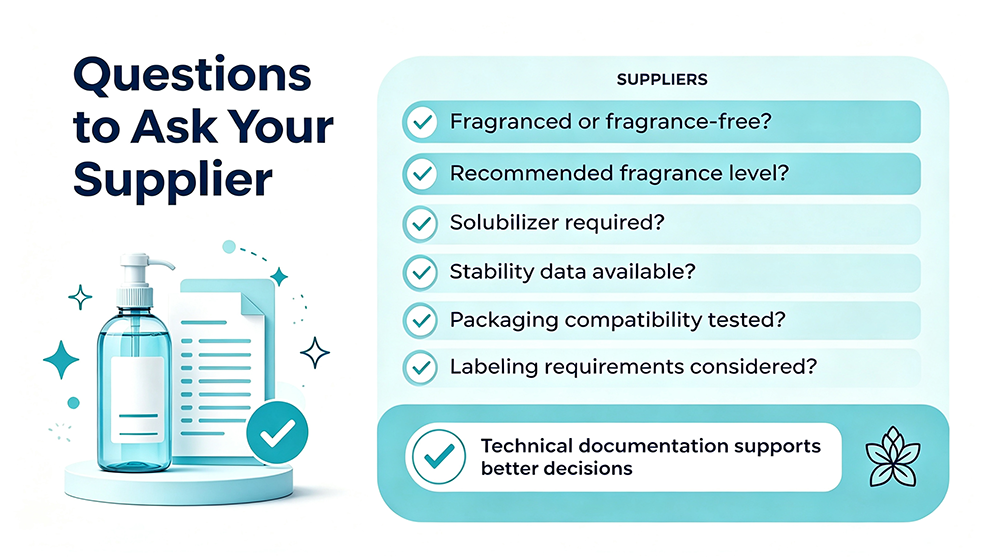
21. What Should Manufacturers Ask Their Wet Wipes Liquid Supplier?
Before selecting a fragranced wet wipes liquid, manufacturers should ask the supplier several practical questions.
1. Is the formulation available in fragranced and fragrance-free versions?
2. What type of fragrance is used?
3. What is the recommended fragrance concentration?
4. Is a solubilizer required?
5. Has the fragrance been evaluated for compatibility with the formulation?
6. What stability testing is available?
7. Has the finished wipe been evaluated in the intended packaging?
8. Can the fragrance be customized?
9. Can the supplier provide relevant technical documentation?
10. Are fragrance-related labeling requirements considered for the target market?
11. Can samples be provided for production trials?
12. Can the formulation be adjusted if the fragrance affects appearance, stability, or sensory performance?
These questions can help manufacturers evaluate a supplier's technical capabilities and reduce avoidable development problems.
22. A Practical Checklist for Fragranced Wet Wipes Development
Before commercial production, manufacturers should confirm the following:
The target application and consumer have been defined.
The fragrance profile has been selected.
The fragrance supplier's recommended use level has been reviewed.
Fragrance compatibility has been evaluated.
Solubility and appearance have been checked.
The finished formulation's pH has been measured where relevant.
Preservation performance has been evaluated where appropriate.
Fragrance stability has been assessed.
The nonwoven substrate has been tested.
Packaging compatibility has been assessed.
The fragrance and ingredient documentation has been reviewed.
Applicable labeling and regulatory requirements have been checked.
Finished-product testing has been completed as required.
Completing these checks helps manufacturers move from fragrance selection to a more reliable commercial formulation.
23. How to Develop a Customized Wet Wipes Liquid With Fragrance
For manufacturers developing a new wet wipes product, fragrance should be considered at the beginning of formulation design.
A customized formulation can be developed according to:
Product application
Target market
Desired fragrance profile
Required scent intensity
Fragrance-free requirements
Surfactant system
Preservative system
pH requirements
Nonwoven substrate
Packaging format
Cost target
For example, a household cleaning wipe may prioritize a fresh fragrance and effective cleaning, while a baby wipe may prioritize mildness and may be developed without added fragrance.
A facial wipe may require a different balance of ingredients and sensory properties from a floor cleaning wipe.
There is no single fragrance system that is ideal for every application.
The best formulation is one that balances the fragrance experience with stability, compatibility, safety, regulatory compliance, and commercial requirements.
24. Our Approach to Fragranced and Fragrance-Free Wet Wipes Liquid
At WipesLiquid, we focus on supplying liquid formulations for wet wipes manufacturers and brands developing different types of wet wipes products.
We understand that fragrance selection needs to be coordinated with the complete liquid formulation.
Depending on the application, formulation development may consider:
Fragrance-free wet wipes liquid
Fresh-scent cleaning wipes liquid
Citrus-scent cleaning wipes liquid
Fragranced personal care wipes liquid
Mild baby wipes liquid
Customized wet wipes liquid
Fragrance solubilization
Formulation compatibility
Stability evaluation
Nonwoven compatibility
The appropriate solution depends on the intended application and the customer's requirements.
For manufacturers developing a new product, we recommend confirming the target market, desired fragrance profile, nonwoven material, packaging format, and expected product performance before finalizing the formulation.
Samples and appropriate technical information can then support further evaluation and production trials.
Conclusion: Should Wet Wipes Be Fragranced?
There is no universal answer.
Fragrance can help improve the sensory experience and differentiate certain wet wipes products. However, it also introduces additional formulation considerations, including solubility, compatibility, stability, packaging interactions, safety assessment, and labeling requirements.
Fragrance-free wet wipes may be preferable for some personal care applications, while fragranced formulations may be suitable for products where scent is an important part of the user experience.
For wet wipes manufacturers, the most important principle is to select fragrance according to the intended application and evaluate it as part of the complete wet wipes liquid formulation.
A successful fragranced wet wipe is not simply a product that smells pleasant immediately after manufacturing. It should also maintain acceptable appearance, fragrance quality, stability, and performance throughout its intended shelf life.
If you are looking for a fragranced or fragrance-free wet wipes liquid for your production line, contact us to discuss your application, target market, fragrance preferences, and formulation requirements.
We can help you evaluate suitable wet wipes liquid solutions for your next product development project.