





 English
 USA
 西班牙语
 俄罗斯
 葡萄牙
 印尼
 巴基斯坦
 尼日利亚
 孟加拉
 墨西哥
 越南
 日本
 韩国
 沙特阿拉伯

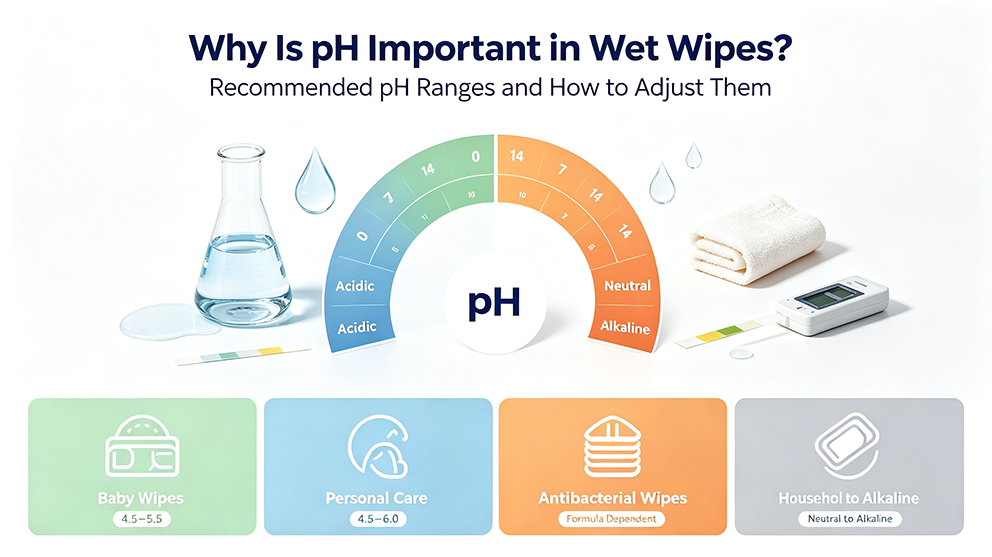
When developing a wet wipes product, manufacturers often focus on ingredients, cleansing performance, fragrance, and preservation systems. However, one important parameter should never be overlooked: pH value.
The pH of wet wipes liquid can influence skin compatibility, ingredient stability, preservative effectiveness, and overall product performance. Different types of wet wipes also require different pH targets. A baby wipe, makeup remover wipe, antibacterial wipe, and household cleaning wipe should not necessarily use the same pH range.
So, what is the ideal pH for wet wipes? Why does it matter? And how can manufacturers adjust pH during formulation development?
This article explains the key considerations for wet wipes manufacturers and why liquid formulation plays such an important role in achieving the desired pH.
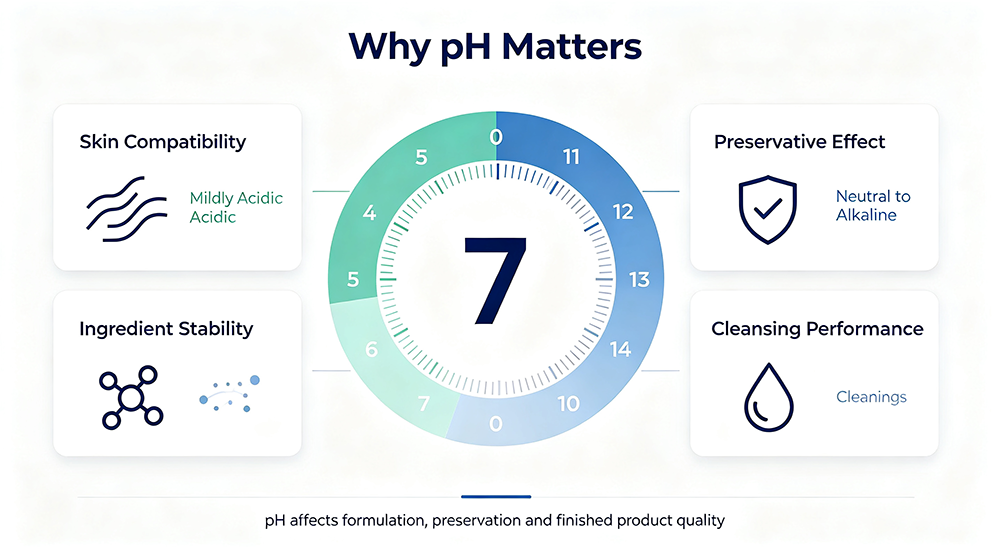
1. What Is pH and Why Does It Matter in Wet Wipes?
pH is a measurement of how acidic or alkaline an aqueous solution is, usually expressed on a scale from 0 to 14.
· pH below 7: Acidic
· pH equal to 7: Neutral
· pH above 7: Alkaline
For wet wipes manufacturers, pH is more than a laboratory specification. It is an important formulation parameter that can affect several aspects of the finished product.
1. Skin compatibility
Healthy human skin generally has a slightly acidic surface pH, commonly reported around 4.5–5.5, although it varies by individual, body area, age, and other factors.
For wipes intended for skin contact, selecting an appropriate pH can help support skin compatibility. This is particularly important for baby wipes and products designed for frequent use.
2. Preservative effectiveness
The effectiveness of a preservative system may depend on the pH of the formulation.
Some preservatives work within a relatively specific pH range, while others are less sensitive to pH changes. If the formulation pH is outside the suitable range, preservative performance may be affected.
Therefore, pH adjustment should always be considered together with the preservation system and microbiological testing.
3. Ingredient stability and compatibility
Some functional ingredients are more stable under acidic conditions, while others perform better in neutral or alkaline environments.
An unsuitable pH may affect ingredient solubility, product appearance, fragrance stability, or the performance of certain active ingredients.
4. Cleansing performance
The pH of a wet wipes liquid can influence the behavior of certain surfactants and other functional ingredients.
For household cleaning wipes, the required pH may depend on the type of dirt, cleaning target, surface material, and intended application.
2. What Is the Recommended pH Range for Different Wet Wipes?
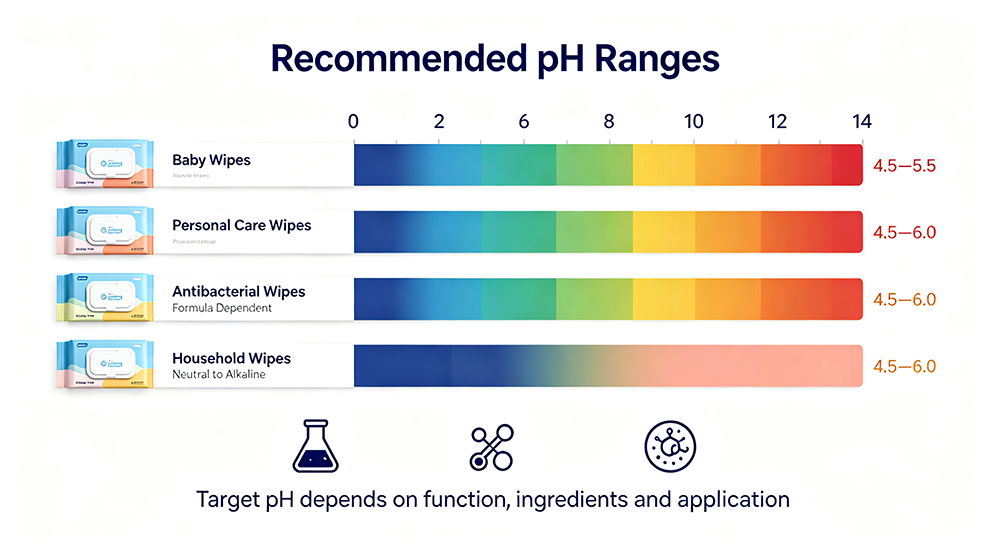
There is no single pH range suitable for every wet wipes product. The target should be determined according to product application, ingredient compatibility, consumer requirements, and applicable regulations.
The following ranges are practical formulation starting points, not universal legal standards or mandatory specifications.
| Wet Wipes Type | Indicative pH Range | Main Considerations |
| Baby wipes | 4.5–5.5 | Gentle cleansing and compatibility with infant skin |
| Sensitive skin wipes | 4.5–5.5 | Mild formulation and skin compatibility |
| Personal care wipes | 4.5–6.0 | Skin comfort and cleansing performance |
| Makeup remover wipes | 4.5–6.0 | Cleansing efficiency and skin compatibility |
| Facial cleansing wipes | 4.5–6.0 | Mild cleansing and skin feel |
| Antibacterial skin wipes | Formula-dependent | Active ingredient efficacy and skin compatibility |
| Disinfecting surface wipes | Formula-dependent | Disinfectant active ingredient and validated efficacy |
| Household cleaning wipes | Formula-dependent, often neutral to alkaline | Cleaning performance and surface compatibility |
| Glass cleaning wipes | Formula-dependent, often neutral to alkaline | Streak-free cleaning and surface compatibility |
Baby Wipes: Why Is pH Around 5.5 Commonly Used?
Baby skin is particularly sensitive, especially during the early stages of life. Research and industry recommendations commonly support slightly acidic baby wipe formulations designed to maintain skin surface pH around 5.5.
A suitable formulation may include:
· Mild cleansing surfactants
· Appropriate moisturizing ingredients
· A suitable preservative system
· A pH adjustment and buffering system
A buffered formulation can help maintain pH more consistently during storage and use.
Personal Care and Facial Wipes
Facial wipes, makeup remover wipes, and general personal care wipes are commonly developed within a mildly acidic range.
However, the target pH should also consider the cleansing ingredients, fragrance, skin-conditioning components, and intended application.
For example, a makeup remover wipe must balance makeup removal performance with an acceptable skin feel and appropriate product safety.
Antibacterial and Disinfecting Wipes
Antibacterial and disinfecting wipes require additional consideration.
The pH must be compatible with the selected antimicrobial active ingredient and its validated efficacy requirements.
For example, the effective pH range of one antimicrobial system may differ significantly from another. Manufacturers should not simply adjust these products to pH 5.5 because that is commonly used for skin-care wipes.
The final formula must be evaluated for active ingredient stability, antimicrobial performance, material compatibility, and applicable regulatory requirements.
Household Cleaning Wipes
Household cleaning wipes may require neutral or alkaline formulations, depending on their intended use.
For example:
· Kitchen cleaning wipes may require a suitable grease-removal system.
· Floor cleaning wipes should be compatible with the intended floor materials.
· Glass cleaning wipes may require a formulation designed to minimize streaking.
· Leather cleaning wipes require particular attention to material compatibility and surface finish.
The appropriate pH depends on the cleaning task rather than the natural pH of human skin.
3. How Can Wet Wipes Manufacturers Adjust pH?
During wet wipes liquid formulation development, pH can be adjusted by adding suitable acidic or alkaline ingredients.
The adjustment method depends on the initial pH, the target value, the formula composition, and the buffering capacity of the system.
1. Lowering pH: Using Acidic Ingredients
If the initial formulation is too alkaline, suitable acids can be used to reduce its pH.
Common examples include:
Citric Acid
Citric acid is widely used as a pH adjuster in aqueous formulations. It can help reduce pH and can also be combined with sodium citrate to form a buffer system.
Lactic Acid
Lactic acid is another commonly used organic acid. It can be considered in certain personal care formulations, depending on the intended application and ingredient compatibility.
The appropriate acid should be selected according to the formulation requirements rather than simply choosing the ingredient with the strongest pH-lowering effect.
2. Raising pH: Using Alkaline Ingredients
If the formulation pH is too low, a suitable alkaline ingredient may be used to increase it.
Common examples include:
Sodium Hydroxide
Sodium hydroxide is used in diluted form for pH adjustment in many aqueous formulations. Because it is highly alkaline, it must be handled carefully and added gradually.
Other Suitable Alkaline Adjusters
Depending on the formulation, other alkaline materials or buffering components may be considered.
The selection should take into account ingredient compatibility, intended product use, and applicable safety requirements.
3. Using a Buffer System to Maintain pH
Adjusting the pH once does not necessarily mean that the value will remain stable throughout the product's shelf life.
Some formulations may experience pH changes due to ingredient interactions, raw material variations, or storage conditions.
A buffer system can help resist unwanted pH fluctuations.
For example, a citric acid and sodium citrate system may be used in suitable formulations to help maintain a target pH.
The buffer concentration and ratio should be optimized through formulation testing.
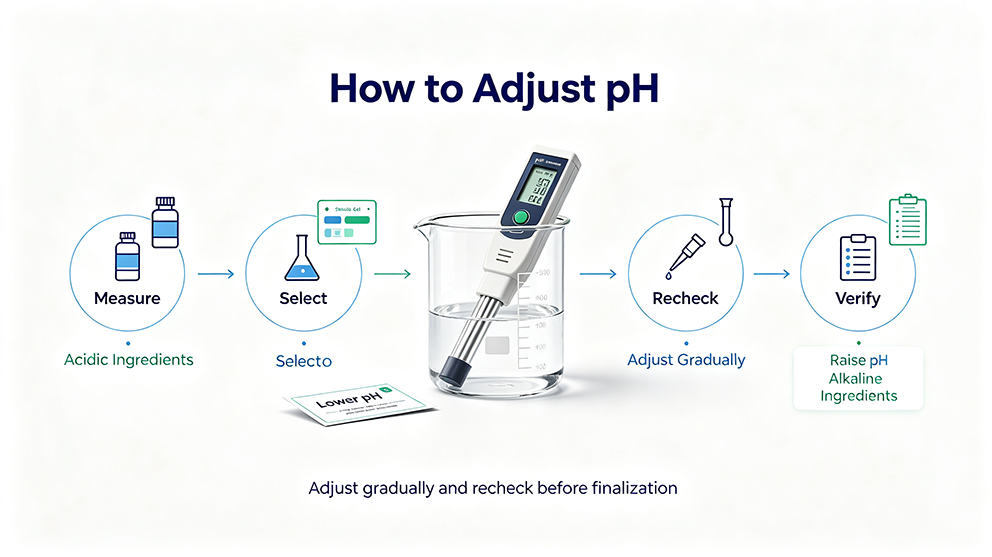
4. A Practical Step-by-Step pH Adjustment Process
For wet wipes liquid manufacturers, pH adjustment should follow a controlled laboratory procedure.
Step 1: Prepare the Initial Formula
Prepare the liquid formulation according to the selected ingredient specifications and manufacturing procedure.
Ensure that the water quality and raw material quality are appropriate for the product.
Step 2: Measure the Initial pH
Use a calibrated pH meter to measure the initial formulation pH.
For reliable results:
· Calibrate the instrument using suitable standard buffer solutions.
· Follow the instrument manufacturer's measurement procedure.
· Maintain consistent sample temperature.
· Allow the reading to stabilize before recording the result.
Step 3: Select a Suitable pH Adjuster
Compare the initial pH with the target pH range.
If the pH is too high, consider a suitable acidic adjuster. If it is too low, consider an appropriate alkaline adjuster.
The selection must also account for the formula's ingredients and preservation system.
Step 4: Adjust Gradually
Add the diluted pH adjuster in small, controlled increments while mixing.
Avoid adding a large amount at once, as this may cause excessive pH changes or localized high or low pH conditions.
Step 5: Recheck and Confirm pH
After mixing, allow sufficient time for the formulation to equilibrate, then measure the pH again.
Repeat the adjustment if necessary until the target is reached.
Step 6: Evaluate the Finished Formulation
After pH adjustment, check other important properties, including:
· Appearance and clarity
· Odor and fragrance stability
· Ingredient compatibility
· Viscosity, where relevant
· Preservative effectiveness
· Stability under appropriate storage conditions
For commercial products, pH should also be checked during pilot production and bulk manufacturing.
5. Why Is the pH of Wet Wipes Liquid So Important?
One important point for wet wipes manufacturers is that the pH of the finished product is closely connected to the liquid formulation.
The liquid is not simply water added to a nonwoven fabric. It is a carefully designed system containing multiple functional ingredients.
Consider the following examples:
· A baby wipes formula needs a suitable combination of mild surfactants, moisturizing ingredients, preservatives, and pH buffers.
· A makeup remover formula needs a compatible cleansing system that performs effectively at the selected pH.
· An antibacterial wipes formula must consider the relationship between pH and antimicrobial active ingredient performance.
· A household cleaning wipes formula needs a pH suitable for its cleaning purpose and intended surfaces.
Changing one ingredient may influence the pH or stability of the entire formulation.
This is why successful wet wipes development requires more than simply adding an acid or alkali to achieve a numerical target.
The complete liquid formulation must be evaluated to ensure that pH, cleansing performance, preservation, ingredient compatibility, and finished product quality work together.
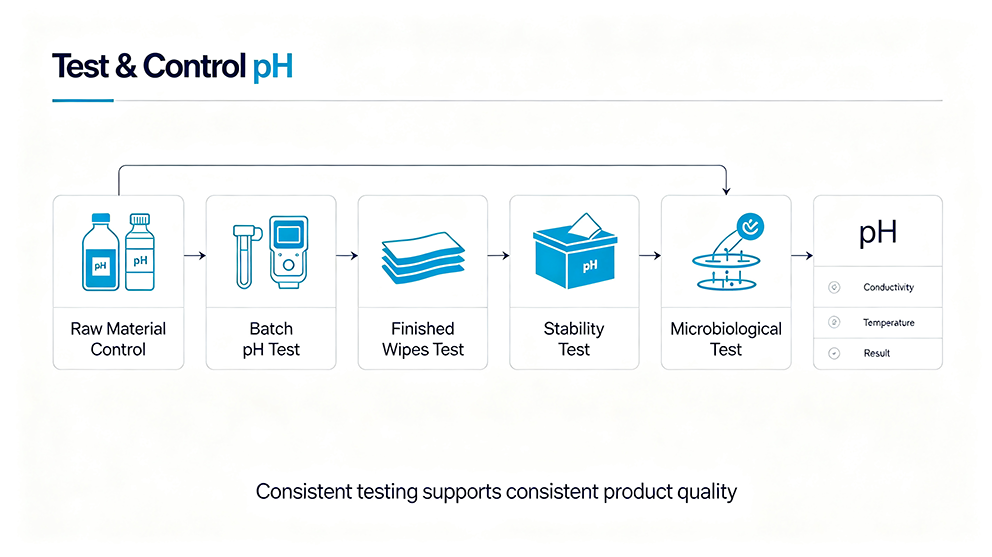
6. How Should Wet Wipes Manufacturers Test and Control pH?
A laboratory pH result is only one part of quality control. Manufacturers should establish consistent testing procedures throughout production.
Important considerations include:
Raw Material Control
Check the quality and specifications of incoming ingredients, especially water and materials that may influence pH.
Batch pH Testing
Measure and record pH during formulation preparation and before batch release.
Finished Wipes Testing
The liquid inside a wet wipe may interact with the nonwoven fabric and packaging during storage. Therefore, manufacturers should establish a consistent method for evaluating the pH of the finished wipes.
For example, a defined extraction procedure can be used to obtain liquid from the wipes before measurement. The extraction method, sample preparation, and temperature should remain consistent so that results can be compared reliably.
Stability Testing
Monitor pH changes during appropriate stability studies to evaluate whether the formulation maintains its specifications over time.
Microbiological Testing
A suitable pH does not replace an effective preservation system. Manufacturers should conduct appropriate microbiological quality testing and preservation efficacy evaluations according to the product type and applicable requirements.
Conclusion: The Right pH Starts with the Right Wet Wipes Liquid Formulation
pH is an important parameter in wet wipes development, influencing skin compatibility, ingredient stability, preservation performance, and cleaning effectiveness.
However, different wet wipes products require different pH targets. Baby wipes and facial wipes generally favor mildly acidic formulations, while household cleaning and disinfecting wipes must be developed according to their specific functions and active ingredients.
For wet wipes manufacturers, the key is not simply to achieve a particular pH number. It is to develop a complete liquid formulation in which every ingredient works together to deliver the desired performance, stability, and quality.
At Wipes Liquid, we specialize in customized wet wipes liquid formulation solutions for global wet wipes manufacturers and private-label brands.
Whether you are developing baby wipes, personal care wipes, makeup remover wipes, antibacterial wipes, or household cleaning wipes, our team can help evaluate suitable ingredients, pH targets, preservation systems, and formulation requirements.
Looking for a customized wet wipes liquid formulation? Contact us to discuss your product requirements and development goals.