





 English
 USA
USA
 西班牙语
西班牙语
 俄罗斯
俄罗斯
 葡萄牙
葡萄牙
 印尼
印尼
 巴基斯坦
巴基斯坦
 尼日利亚
尼日利亚
 孟加拉
孟加拉
 墨西哥
墨西哥
 越南
越南
 日本
日本
 韩国
韩国
 沙特阿拉伯
沙特阿拉伯

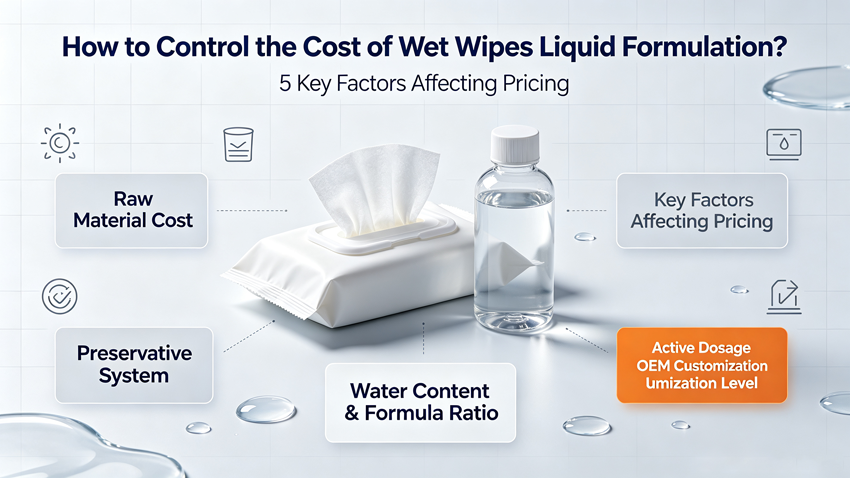
In today’s increasingly competitive wet wipes industry, many manufacturers face a core question:
Why do formulations that look similar have very different costs?
Especially in OEM/ODM production, the liquid formulation is often the key factor determining cost, quality, and market positioning of wet wipes.
This article breaks down five core cost drivers of wet wipes liquid formulations from a practical manufacturing and procurement perspective, helping you better control costs while avoiding quality risks.
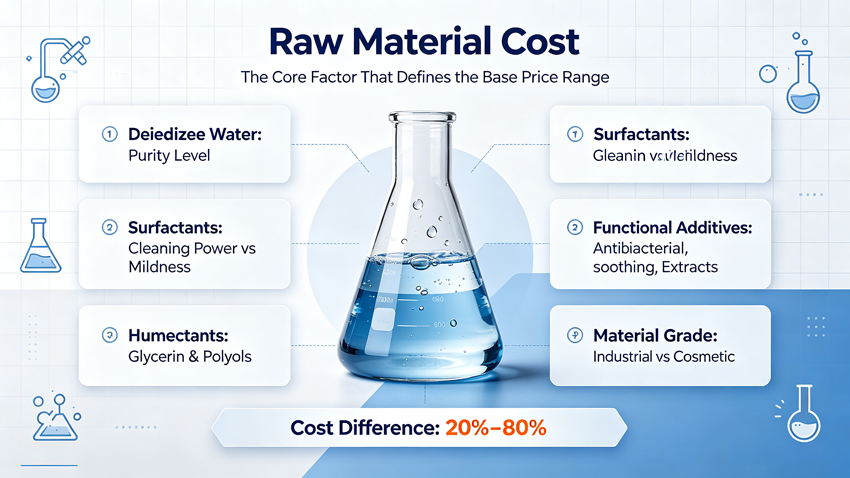
1. Raw Material Cost: The Core Factor That Defines the “Base Price Range”
The first and most important cost component of wet wipes liquid formulation is the raw material structure.
Different material grades can lead to significant cost differences, such as:
Deionized water (basic cost, but varies by purity level)
Surfactants (balance between cleaning power and mildness)
Humectants (e.g., glycerin, polyols)
Functional additives (antibacterial agents, soothing agents, botanical extracts)
Key point:
For the same “cleaning wipes” product, using industrial-grade raw materials vs cosmetic-grade raw materials can result in a cost difference of 20%–80%.
For manufacturers, raw material selection determines the “cost ceiling” of the product.
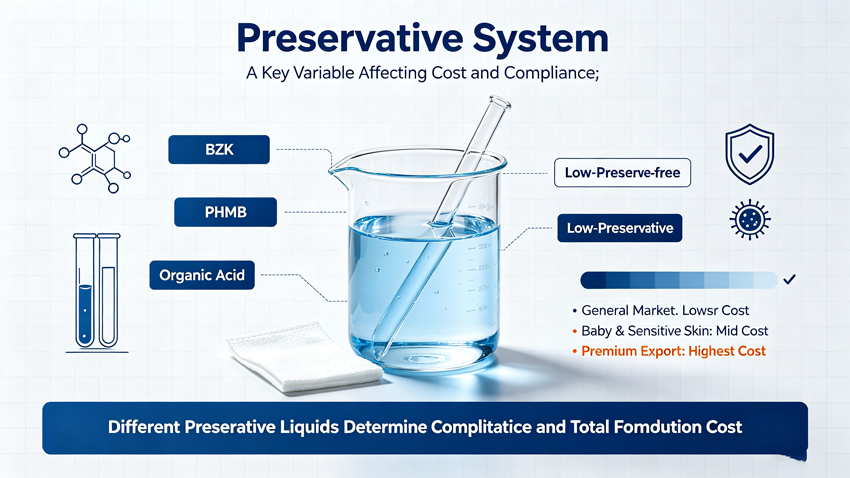
2. Preservative System: A Key Variable Affecting Cost and Compliance
The preservative system is one of the most underestimated yet critical parts of wet wipes formulations.
Common systems include:
Benzalkonium Chloride (BZK)
Cetylpyridinium Chloride (CPC)
Polyhexamethylene Biguanide (PHMB)
Organic acid systems
Preservative-free / low-preservative systems (premium products)
Cost impact logic:
Strong preservative systems: lower cost, but may limit export markets
Mild preservative systems: higher cost, suitable for baby/sensitive skin products
Preservative-free systems: highest cost, require strict manufacturing and packaging conditions
Many European and American customers prefer to increase cost in exchange for compliant systems.
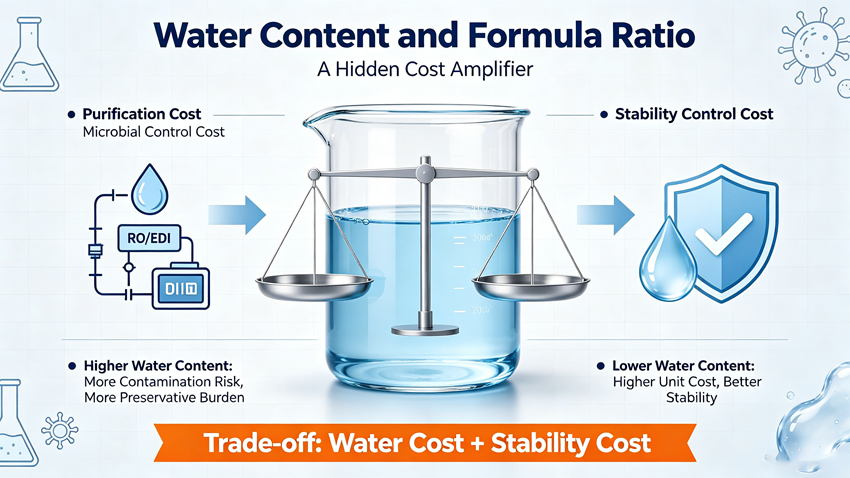
3. Water Content and Formula Ratio: A Hidden “Cost Amplifier”
One often overlooked factor is that water is also part of the cost structure.
A wet wipes formulation is not simply “the more diluted, the cheaper,” because of:
Purification cost (RO/EDI systems)
Microbial control costs
Stability control costs
Increased preservative burden
General principle:
Higher water content = higher risk of contamination = stronger reliance on preservatives
Lower water content = more concentrated formula = higher unit cost but better stability
In essence, it is a trade-off between “water cost + stability cost.”
4. Active Dosage: The Key Factor Behind “Same Formula, Different Prices”
Even with the same raw materials, different dosage levels can lead to completely different costs.
For example:
Antibacterial ingredient: 0.1% vs 0.5%
Moisturizing system: 1% vs 5%
Botanical extract concentration differences
Core logic:
Higher dosage does NOT always mean better—it means higher cost and greater complexity.
Because it increases not only raw material cost, but also:
Stability challenges
Odor/color changes
Compatibility issues
Many premium wipes are expensive not because the ingredients are costly, but because they are used at higher concentrations.
5. OEM Customization Level: The Biggest Hidden Cost Driver
This is often overlooked by procurement teams.
Wet wipes formulation cost is not only “material cost,” but also includes:
Custom development fees
Sampling iterations
Stability testing costs
Regulatory compliance adjustments (EU / US / REACH / FDA)
Exclusive formula protection costs
Cost tiers:
Standard formula (stock formula): lowest cost
Semi-custom formula (adjusted formula): medium cost
Fully custom OEM/ODM formula: highest cost
The higher the customization level, the higher the unit cost—but also the stronger the market competitiveness.
Summary: Wet Wipes Liquid Formulation Cost Is a System of Five Variables
The cost is not driven by a single factor, but by an integrated structure:
Raw materials determine base cost
Preservative system determines compliance and market access
Water content affects stability and control costs
Active dosage determines functionality and price ceiling
OEM customization determines R&D and service costs
Practical Suggestions for Wet Wipes Manufacturers
When doing product selection or cost optimization, you can focus on:
Clearly define target markets (baby / adult / medical / pet)
Avoid blindly increasing active dosage
Optimize preservative systems instead of simply cutting costs
Improve formula structure rather than simply reducing concentration