





 English
 USA
USA
 西班牙语
西班牙语
 俄罗斯
俄罗斯
 葡萄牙
葡萄牙
 印尼
印尼
 巴基斯坦
巴基斯坦
 尼日利亚
尼日利亚
 孟加拉
孟加拉
 墨西哥
墨西哥
 越南
越南
 日本
日本
 韩国
韩国
 沙特阿拉伯
沙特阿拉伯

When many people first encounter flushable wet wipes, they assume they are basically the same as ordinary wet wipes.
But for factories that truly manufacture flushable wipes, the most critical part is not the nonwoven fabric or the packaging — it is the liquid formula inside.
Especially for antibacterial flushable wet wipes.
What consumers notice are words like “soft,” “clean,” “antibacterial,” and “flushable.”
But the real technical challenges manufacturers face are far more complicated.
For example:
Why do some flushable wipes cause a burning sensation after use?
Why do some products turn yellow after three months?
Why does the antibacterial effect work in theory but fail customer testing?
Why does a stable formula still clog pipes?
Why do some wipes smell like disinfectant?
Why do European customers avoid Benzalkonium Chloride (BZK)?
Why are baby-grade products becoming increasingly difficult to formulate?
Ultimately, all of these questions come back to one thing:
The wet wipe liquid formula.
And in the future, competition in the flushable wet wipe industry will likely shift away from simply competing on price — and toward competing on formulation capability.
In this article, we’ll explain in the simplest and most practical way:
What antibacterial flushable wet wipe solution really is
Why it is becoming increasingly important
What kinds of formulations are currently trending in the global market
1. What Is an Antibacterial Flushable Wet Wipe Solution?
Simply put:
The wet wipe solution is the liquid absorbed inside the flushable wipe.
Consumers see a moist sheet.
But in reality, over 80% of the user experience of a qualified flushable wipe comes from the liquid formula.
Because the liquid determines:
Wiping comfort
Cleaning performance
Mildness
Antibacterial performance
Moisturizing effect
Odor
Irritation level
Storage stability
Resistance to mold growth
Resistance to discoloration
Allergy risk
Especially for antibacterial flushable wipes.
Many factories initially make the same mistake:
“As long as we add an antibacterial agent, it should work.”
But after actual production, they quickly realize:
Not every antibacterial ingredient is suitable for flushable wipes.
Because flushable wipes are a very specialized product category:
They contact intimate skin areas
They require long-term storage stability
They must remain low-irritation
They contain high liquid loading
They must work with flushable substrates
They must comply with regulations in different countries
So a mature antibacterial flushable wipe formula is never just about “adding ingredients.”
It is a complete balancing system.
2. Why Are Antibacterial Flushable Wipes Becoming So Popular?
In the past, most consumers simply used dry toilet paper.
Today, however, more and more people are embracing the concept of “water-based cleaning.”
This trend is growing especially fast in:
Southeast Asia
The Middle East
Europe
North America
Latin America
The reasons are actually very practical.
1) Consumers Are Paying More Attention to Hygiene
After the pandemic, global consumers became far more sensitive to concepts like:
Antibacterial protection
Hygiene
Cleanliness
Many people are now accustomed to:
Using disinfecting wipes outdoors
Cleaning hands before meals
Using baby wipes
Using flushable wipes after toilet use
Flushable wet wipes are gradually shifting from an “optional product” to a daily household necessity.
2) Ordinary Toilet Paper Has Limited Cleaning Ability
This is one of the most convincing selling points for flushable wipes.
Dry paper can only remove surface residue.
But flushable wipes provide:
Better cleanliness
More comfort
Less residue
Gentler wiping
Especially for:
Women
Families with babies
People with hemorrhoids
Sensitive skin users
Demand for flushable wet wipes continues to grow rapidly.
3) “Antibacterial” Claims Increase Product Value
The price competition in ordinary flushable wipes has become extremely intense.
But once products add concepts such as:
Antibacterial
Gentle
Natural
Alcohol-free
Preservative-free
Sensitive skin
Baby-grade
the product value increases immediately.
That’s why more and more wipe manufacturers are seeking differentiated formulations.
And antibacterial flushable wipe solution is one of the most important areas.
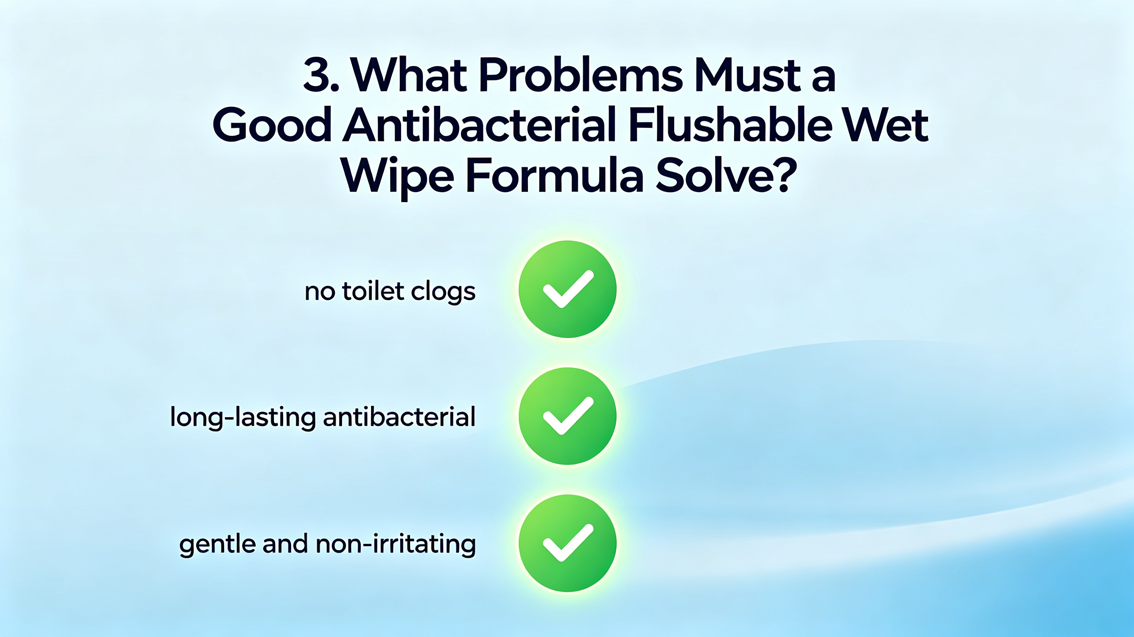
3. What Problems Must a Good Antibacterial Flushable Wet Wipe Formula Solve?
Many customers discover that developing antibacterial flushable wipes is far more complicated than expected.
Because being “effective” alone is not enough.
The formula must simultaneously achieve:
Effective antibacterial performance
Low irritation
Skin safety
Substrate compatibility
Flushability compatibility
No yellowing
No precipitation
No unpleasant odor
No microbial growth
Regulatory compliance
This requires extensive formulation experience.
4. Common Components in Antibacterial Flushable Wet Wipe Solutions
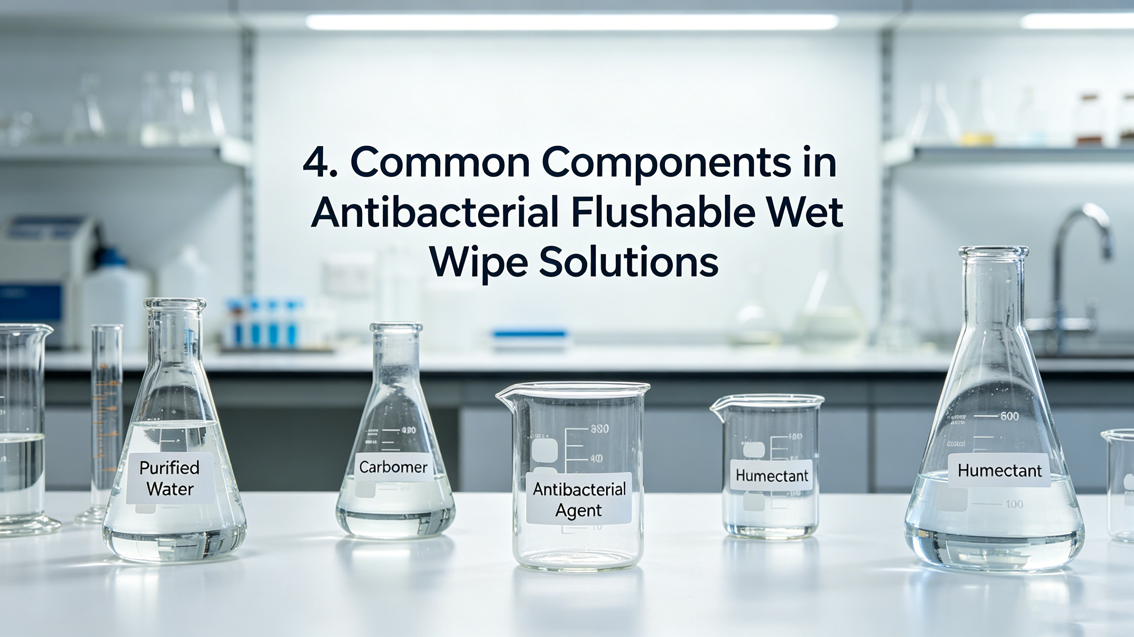
Although formulations vary from brand to brand, most antibacterial flushable wipe liquid systems contain the following components.
1) Purified Water
This is the main part of the formula.
Many consumers think “water is just water.”
But in reality, it is not.
The water used in flushable wipes typically requires:
RO purified water
Deionized water
Multi-stage filtration
Microbial control
Because water itself can easily become contaminated.
If the water system is not properly controlled, even the most expensive formula may fail.
2) Antibacterial Ingredients
This is the core of antibacterial flushable wipes.
Common systems currently used in the market include:
BZK (Benzalkonium Chloride)
CPC (Cetylpyridinium Chloride)
PHMB
Natural antibacterial systems
Organic acid systems
Fermentation-based antibacterial systems
However, regulatory requirements differ across countries.
For example:
Some European customers avoid traditional quaternary ammonium systems.
Meanwhile, premium baby-grade products are increasingly moving toward:
Mild formulations
Low-irritation systems
Natural concepts
“Free-from” formulations
As a result, many brands are now searching for alternative antibacterial technologies.
3) Moisturizing Ingredients
If a formula only contains antibacterial agents without a moisturizing system, the user experience becomes poor.
Many low-end wipes may leave skin feeling:
Dry
Stinging
Tight
That’s why formulas often include ingredients such as:
Glycerin
Aloe vera
Botanical extracts
Panthenol
Sodium lactate
The goal is to improve skin comfort.
4) Mild Cleansing Ingredients
Some flushable wipes contain small amounts of surfactants.
The purpose is not aggressive cleaning.
Instead, they help improve the overall fresh and clean feeling after wiping.
But there is a key issue:
Too much surfactant can increase irritation.
Especially in intimate care applications.
Therefore, premium flushable wipes increasingly prefer:
Ultra-low foam systems
Low-irritation surfactants
Mild cleansing systems
5) Preservative System
Many people ask:
“If the formula already contains antibacterial agents, why is preservation still necessary?”
Because these are two different concepts.
The “antibacterial” claim usually targets the usage scenario.
But the product itself must also remain microbiologically stable during storage.
Since flushable wipes are high-water-content products, poor preservation can easily lead to:
Microbial contamination
Bad odor
Yellowing
Swollen packaging
Consumer complaints
That’s why mature flushable wipe formulations always include a complete preservation and stability system.
5. Why Are Antibacterial Flushable Wet Wipes So Difficult to Formulate?
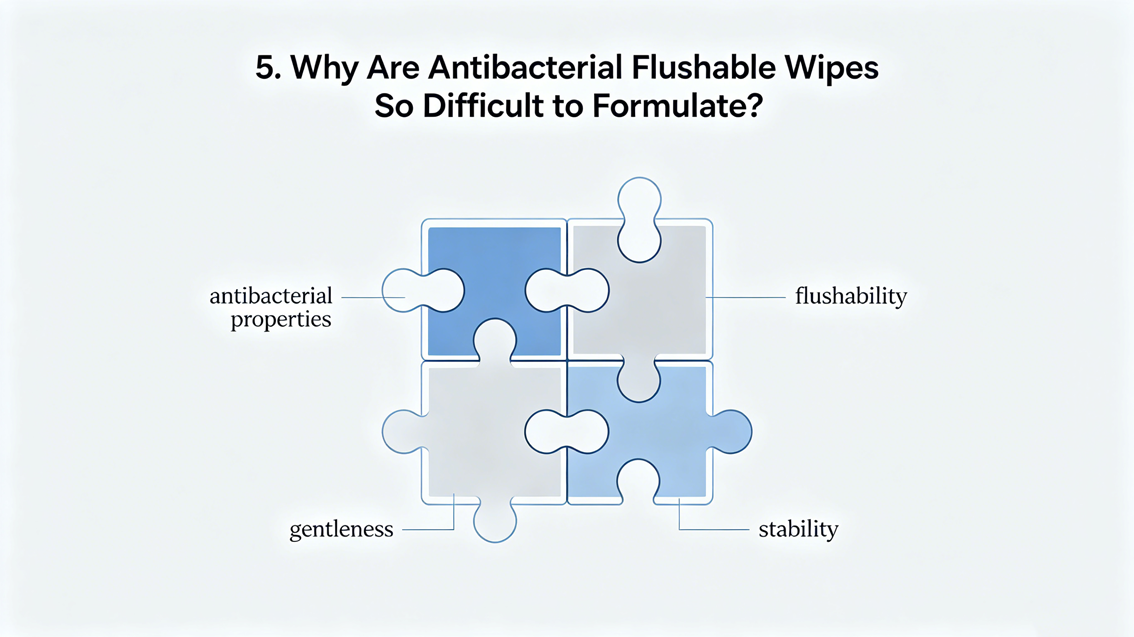
Because they are inherently a “contradictory product.”
What does that mean?
Consumers want products that are:
Highly antibacterial
Extremely gentle
Flushable
Non-irritating
Natural
Affordable
Long-term stable
But in reality, many of these performance targets conflict with one another.
For example:
1) Stronger Antibacterial Systems Often Mean Higher Irritation Risk
Many highly effective antibacterial systems can also irritate sensitive skin.
Especially intimate skin areas.
That’s why premium products increasingly emphasize:
“Balance”
Instead of simply pursuing maximum kill rates.
2) Flushable Substrates Are More Sensitive to Liquid Systems
One major difference between flushable wipes and ordinary wet wipes:
Flushable wipes must disperse in water.
Therefore, the substrate structure is more delicate.
If the liquid system is incompatible, it may:
Make the substrate brittle
Cause linting
Reduce tensile strength
Affect flushability speed
This is why many manufacturers place enormous importance on formula-substrate compatibility.
3) Natural Formulations Are Harder to Stabilize
Today, many brands promote concepts such as:
Alcohol-free
MIT-free
Phenoxyethanol-free
Fragrance-free
Preservative-free concepts
But the cleaner the formula concept becomes, the harder stability becomes.
That’s why truly mature natural antibacterial flushable wipe formulas require very high technical expertise.
6. What Types of Antibacterial Flushable Wet Wipe Formulas Are Trending Globally?
Based on the current global wipes market, several clear trends are emerging.
1) Gentler Formulations
In the past, many products focused on “strong antibacterial power.”
Today, consumers care more about:
Will it sting?
Will it irritate?
Can it be used daily?
Is it suitable for sensitive skin?
As a result, mild formulations are growing rapidly.
2) Natural Concepts
Especially in Europe and North America.
More brands now emphasize:
Plant-derived ingredients
Natural antibacterial systems
“Free-from” concepts
Clean Label formulations
Consumers are paying increasing attention to ingredient lists — not just price.
3) Low-Preservative Systems
Many premium brands are reducing traditional preservatives.
But that does not mean “no preservation.”
Instead, they aim to achieve lower irritation through more advanced system design.
This requires extensive formulation expertise.
4) Baby-Grade Standards for Adult Products
Previously, only baby wipes emphasized gentleness.
Today, many adult flushable wipes are also adopting:
Baby-grade standards
Sensitive skin concepts
pH-balanced systems
Fragrance-free formulations
Because consumers are paying more attention to skin comfort.
7. Why Are More Wet Wipe Factories Seeking Professional Liquid Formula Suppliers?
In the past, many factories developed formulas themselves.
But today, it is becoming increasingly difficult.
Because the market has shifted from simply “being able to make products” to “making them well.”
Especially in export markets.
Different countries have:
Different regulations
Different restricted ingredients
Different microbiological standards
Different customer requirements
Many factories discover:
They can produce ordinary wipes — but premium antibacterial flushable wipes are much harder to stabilize.
As a result, more manufacturers are partnering with professional liquid formulation suppliers.
Because professional suppliers provide more than just liquid concentrates.
They also provide:
Formulation expertise
Stability experience
Regulatory knowledge
Alternative ingredient solutions
Antibacterial system development
Compatibility testing experience
Cost optimization capability
This is why wet wipe liquid solutions are becoming increasingly specialized.
8. The Future of Antibacterial Flushable Wet Wipes
Over the next few years, the antibacterial flushable wipe market will likely continue growing.
But the focus of competition will change.
The future may no longer depend mainly on:
Packaging
Price
Fragrance
Instead, competition will center around:
Mildness
Formula safety
Natural concepts
Stability
Regulatory compliance
User experience
Long-term repurchase rates
Especially in the premium market.
The real competitive advantage is often not the fabric.
It is the liquid formula.
Because what consumers ultimately remember is the usage experience.
And most of that experience comes from the formulation.
9. Conclusion
Many people think flushable wipes are just a “small product.”
But once you enter the industry, you realize that behind one small wipe lies:
Chemistry
Microbiology
Skin science
Regulatory compliance
Material compatibility
Stability engineering
User experience design
Especially antibacterial flushable wipes.
They are not simply about “adding antibacterial agents.”
They are about building a complete balance system.
For wipe manufacturers, future competitiveness will increasingly depend on mature liquid formulation capabilities.
And for brands, the products consumers continue to repurchase will always be the ones that feel:
“Clean, comfortable, and safe.”
That is exactly why more and more wet wipe manufacturers around the world are focusing on antibacterial flushable wet wipe liquid solutions.