





 English
 USA
USA
 西班牙语
西班牙语
 俄罗斯
俄罗斯
 葡萄牙
葡萄牙
 印尼
印尼
 巴基斯坦
巴基斯坦
 尼日利亚
尼日利亚
 孟加拉
孟加拉
 墨西哥
墨西哥
 越南
越南
 日本
日本
 韩国
韩国
 沙特阿拉伯
沙特阿拉伯

1. Market Background: BKC in Wipe Formulations
The global wipes market has experienced continuous growth in recent years. Product categories have expanded from basic cleaning wipes to antibacterial wipes, disinfecting wipes, personal care wipes, and professional-use wipes.
In this context, the choice of antimicrobial ingredients in wet wipe formulations has become a critical factor for wipe manufacturers and brands.
Among various active ingredients, Benzalkonium Chloride (BKC or BAC) is widely used due to its:
Broad-spectrum antimicrobial activity
Good formulation compatibility
Cost-effectiveness
It is particularly valued in B2B custom wipe solutions, where performance, stability, and regulatory compliance are essential.
2. What is Benzalkonium Chloride?
Benzalkonium Chloride is a quaternary ammonium cationic surfactant, often available as a mixture of alkyl chain lengths. Key properties include:
Highly soluble in water, suitable for wet wipe liquids
Combines surface activity with antimicrobial function
Effective at low concentrations
Low odor and light color, making it compatible with wipe formulations
These characteristics make BKC suitable both as an active antimicrobial ingredient and as a minor functional component in the formulation.
3. Antimicrobial Mechanism of BKC in Wipes
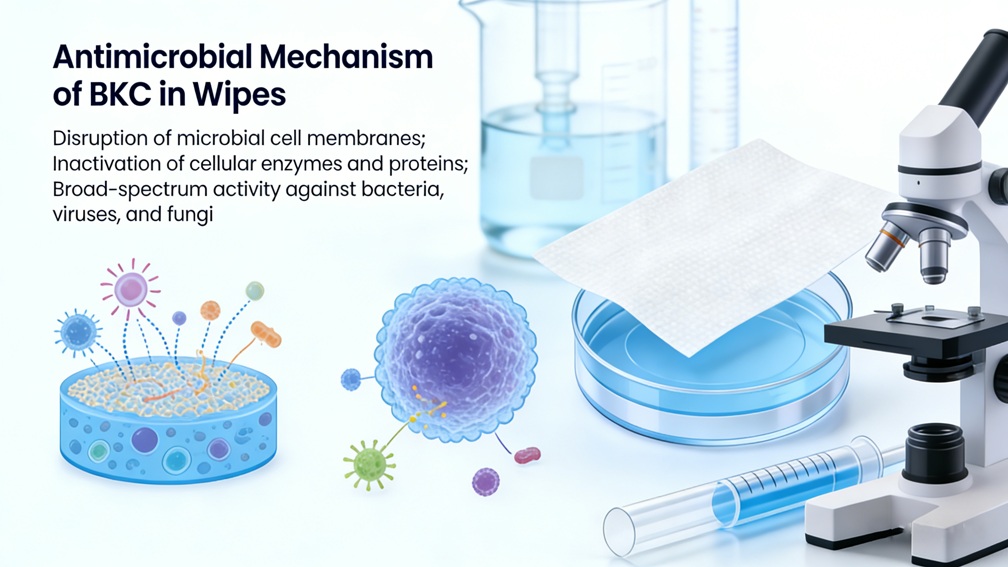
BKC works mainly by:
Disrupting microbial cell membranes
Altering cell membrane permeability, causing leakage of intracellular contents
Denaturing microbial proteins, inhibiting growth
BKC is particularly effective against Gram-positive bacteria and shows activity against some Gram-negative bacteria, fungi, and enveloped viruses. This makes it ideal for antibacterial and disinfecting wet wipes.
4. Typical Applications of BKC in Wipes
4.1 Antibacterial and Disinfecting Wipes
BKC is commonly used in wipes for:
Hand sanitizing wipes
Medical or care antibacterial wipes
Household and public surface cleaning wipes
Compared to alcohol-based wipes, BKC wipes are less volatile, non-flammable, and provide longer-lasting antimicrobial protection, making them suitable for specific applications.
4.2 Baby and Sensitive Skin Wipes (Low Concentration Formulation)
In compliance with market regulations, BKC can be used in:
Baby wipes
Hand-and-mouth wipes
Adult personal care wipes
These wipes typically use lower BKC concentrations and are combined with moisturizing and soothing agents to balance antimicrobial efficacy and skin safety.
4.3 Industrial and Professional-Use Wipes
In B2B markets, BKC is also used in:
Healthcare facility surface wipes
Industrial equipment cleaning wipes
Non-food contact disinfecting wipes
Here, formulation stability, long-lasting antimicrobial performance, and scalability are key considerations.
5. Key Formulation Considerations for BKC Wipes
5.1 Recommended BKC Concentration
Actual concentrations depend on product type and market regulations.
Typical effective concentration: 0.05% – 0.2%
Skin-contact wipes: ≤ 0.1%
Surface disinfecting wipes: adjustable within regulatory limits
5.2 Compatibility with Other Formulation Ingredients
Since BKC is a cationic surfactant, attention is needed:
❌ Avoid anionic surfactants (can reduce efficacy)
✅ Compatible with nonionic and amphoteric surfactants
Common co-ingredients include:
Humectants (glycerin, propylene glycol)
Chelating agents (EDTA-2Na)
Soothing agents (aloe vera, panthenol, allantoin)
A well-designed formulation ensures stability and consistent antimicrobial performance.
5.3 Compatibility with Nonwoven Substrates
BKC wipes are typically compatible with:
Cellulose-based nonwovens
Polyester nonwovens
Wood pulp composite nonwovens
Manufacturers should test long-term soaking, adsorption, and retention of active ingredients to maintain product performance.
6. Regulatory Compliance for BKC Wipes
For export-oriented wipes, BKC usage must comply with target market regulations:
China: Use in disinfectant or cosmetic products depending on product type
European Union (EU): Regulated under BPR (Biocidal Products Regulation); requirements vary by intended use
United States (US): Regulated by FDA / EPA depending on product classification
It is recommended that wipe manufacturers align formulation design with regulatory requirements early in product development.
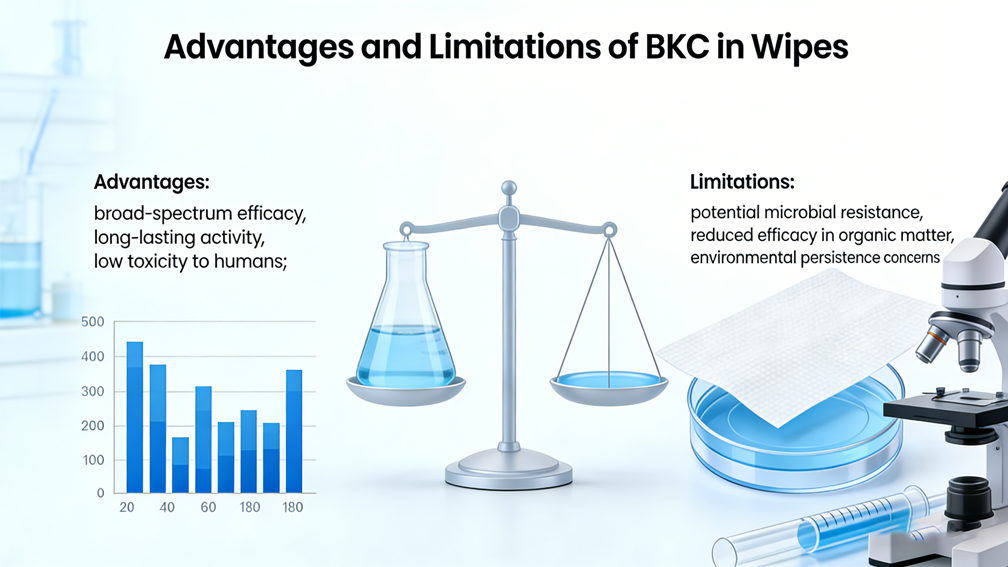
7. Advantages and Limitations of BKC in Wipes
Advantages
Broad-spectrum antimicrobial effect at low concentration
Cost-effective, suitable for large-scale production
Flexible formulation for various wipe types
Gentler than alcohol-based systems, longer-lasting
Limitations
Limited effectiveness against spores
Incompatible with anionic surfactants
High concentrations may cause skin irritation, requiring careful dosage control
8. Conclusion: Professional Formulation Drives Wipe Product Success
As wet wipes continue to evolve in functionality, Benzalkonium Chloride remains a key ingredient in liquid wipe formulations. Successful application depends on:
Rational formulation design
Compatibility with nonwoven substrates
Regulatory compliance in target markets
As a specialist B2B supplier of wet wipe liquid formulations, we offer:
Custom BKC wipe formulations
Market-specific regulatory guidance
Stable, scalable production-ready solutions
Contact us to develop safer, more stable, and market-competitive wet wipes with our technical expertise.